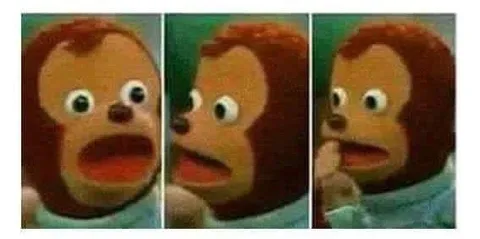
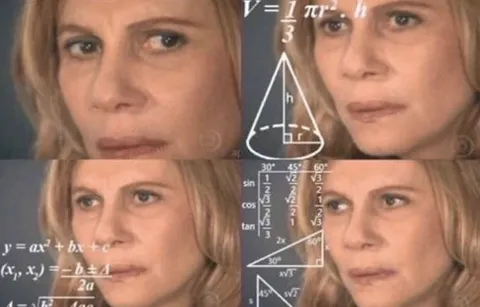
Three frames of one blink
Here are three close-up frames in a row, and the difference between them is minimal. In the first, a man with light hair and stubble looks to the side, eyebrows slightly raised, lips pressed together in a barely noticeable half-smile. In the second, his eyes are closed and his face is slightly tense. In the third, his eyes are open again and aimed in the same direction. Behind him is a blurred, bright, multicolored background with glare, and the image is heavily enlarged, so graininess is visible.
The template's meaning rests on a pause. The person seems to have heard something unexpected, squeezes their eyes shut for a moment to reboot their thoughts, and returns to the conversation. There are no words or gestures: the entire emotion fits into a single blink.
Where the GIF came from
According to meme catalogs, the original clip dates to December 2013 and is taken from a video by the American gaming site Giant Bomb. The man in the frames is identified as site employee Drew Scanlon: he reacts to what happens in the video, where his colleague plays the game Starbound. The video itself was an ordinary work recording, not an ad or a joke designed to go viral.
The GIF remained known to a narrow circle for quite a while. The earliest use found is dated to 2015, but that is only an early known example, not a proven first publication. It became a mass reaction in February 2017, when on Twitter it was attached to a joke about a biology lecture: the narrator is sure they'll cope with the subject, then hears the word “cells” and freezes. That post gathered tens of thousands of reposts, after which the blinking man appeared in thousands of other captions.
How the reaction took root in the Russian-speaking internet
In the Russian-speaking internet, the template came to be called simply the “blinking guy” and is used wherever a slight confusion needs to be shown. It is not anger or horror, but polite bewilderment: the person tries to keep their composure, but their brain clearly can't cope with what they've heard. It is exactly this neutrality that made the GIF universal. It's placed under news, under a conversation partner's absurd claims, under price tags and school assignments.
The static three-frame version is shown here. In this form the template is convenient to insert into comparison memes: the frames unfold like a short story, and the caption explains what provoked the reaction.
Caption examples
Captions for this template usually follow the pattern “expectation, then surprise”: first a calm phrase, then a line that knocks the ground out from under you. A few invented examples follow.
“The first guy to realize that battery percentage and milliamp-hours are not the same thing” — the face freezes halfway between “so what” and “I was sure it was the opposite,” and all the humor lies in that gap.
“Boss: let's gather for five minutes. Calendar: meeting for two hours” — the blink depicts an attempt to accept an unpleasant truth without extra emotion.
“Friend: I hardly spend any money. Card statement: three pages of deliveries” — here the reaction turns into a quiet comment from the side, as if the viewer is hearing the line.
“Teacher: this assignment takes five minutes. The assignment itself: eight pages” — the pause between words and reality is read precisely from the closed eyes in the second frame.
How to use the template
The template works best when the caption is split into two parts: what is said out loud and what is actually happening. Don't explain the reaction with extra words; one contrast is enough. If the caption is too long, the blink gets lost against it.
Another useful rule: the reaction should be restrained. For screaming, panic, and delight, other templates exist. The blinking man is good where the emotion is quiet and almost polite, and the viewer completes the thought that is spinning in the character's head.