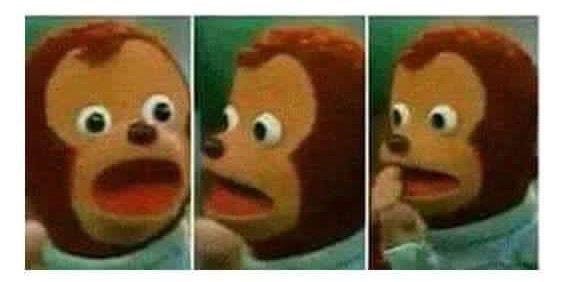
Puppet from a Japanese show
The character appeared in the Japanese children's TV program Ōkiku naru Ko (“Growing Children”), launched in 1959. This is the program's date, not a confirmed year of making this particular puppet. Its constant little face and large eyes are especially expressive in motion: it is enough to turn the head for a simple puppet gaze to look like a reaction.
In the Spanish dub, the character was called Pedro; the Japanese name is given as Kenta or Kento. Thanks to dubbing, the same TV puppet is known to viewers under different names. Decades later, footage from the old children's show became material for independent internet edits: new audiences recognized mainly the big eyes and expressive head turns.
Two different forms of reaction
The two-frame version is linked to Spanish-language memes from 2016 and to Daniel Flores; in 2019 it became visible in English-speaking communities too. This short form keeps the beginning of a look and its turning away. The three-panel image is built differently: the open mouth and the intermediate turn preserve the transition itself.
This difference changes the intonation. Two frames suit instant awkwardness or suddenly noticed liking; three leave room for delayed understanding and an attempt to hide the reaction. The history of the popular two-frame version does not explain the origin of this specific three-frame image.
The pause that the caption completes
In the first frame, the puppet looks straight ahead with its mouth wide open. In the second, it turns to profile; in the third panel, the head returns slightly, the mouth is already closed, and a hand is raised to the chin. Against the almost motionless body, this gesture shifts the tone of the reaction: from sudden surprise to a pause that could be taken for reflection.
When the character is taken out of the children's show, the shape of a response remains, but both the interlocutor and the words disappear. This emptiness does not require knowing the plot of Ōkiku naru Ko: the recognizable puppet carries the expression of a reaction, and a new caption assigns it a reason.
A hand at the chin is often associated with thinking, but the frame itself does not reveal what provoked the reaction. Therefore, the final gesture can be read as thoughtfulness, skepticism or an awkward pause. The caption suggests which of these tones to choose, without making it a trait of a real character.
This kind of edit works not as a single expressive portrait but as a tiny scene with a beginning, a delay and an outcome. A caption can land on any of these moments: first ask a question, then leave the third frame the role of a wordless answer.
Invented captions
“When someone in the group chat asks who took the last slice of pizza.” This is an invented example: the direct look resembles instant recognition, and the turn of the head resembles an attempt not to give oneself away.
“I accidentally turned on the mic while arguing with the navigation app.” In this invented caption, the three frames show the second between realizing a mistake and hoping no one noticed it.