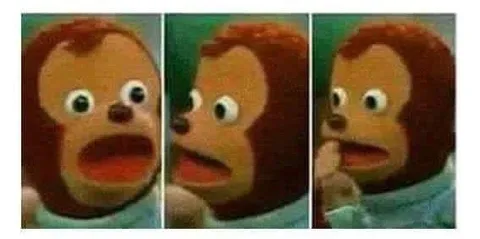
A monkey from a school sitcom
The frame comes from the series Ned’s Declassified School Survival Guide. The monkey appears in the “Mondays” part of the paired episode “Vice Principals/Mondays,” the fifth episode of the second season, which aired on November 5, 2005. Ned and his friends try to make Monday more fun. One of their schemes involves a monkey brought to school, but its scream causes a commotion and chaos among the students.
The TV scene is much older than the wave of recognizable internet jokes. Among the early traces of the image is a political illustration from 2013. A more noticeable stage is linked to a post by SalvadorTheUpvoter on Imgur on June 30, 2016: the scream accompanied a viewer’s disappointment on discovering the show’s ending. In July 2018 the image spread widely through Russian-language VK communities, where the phrase about the “confused monkey” took hold. These dates describe different stages in the frame’s circulation, not a single common birth date.
What the short crop shows
The photo prominently shows a small monkey. Light fur frames its face and covers its chest, while its hands look dark. Its mouth is open, its eyes are turned slightly upward, and its head is tilted back. Behind the animal is a person in blue clothing with dark and light stripes. The crop removes the school setting and the other participants in the scene, so attention falls entirely on the animal’s facial expression.
There is no caption and no visible object that could explain the fright, so the viewer easily supplies their own cause. The eyes and open mouth are especially striking: a single glance is enough to hear an imagined yell. At the same time, a still image conveys only the chosen moment of the TV scene; the sequence of actions and the real reason for the animal’s behavior are not shown in it.
A small trigger for a huge scream
The main comic device is the mismatch between the event and the reaction. The caption might describe a forgotten password, a missed bus, or a surprise test, while the image expresses horror on the scale of an adventure movie. This makes an everyday hiccup funnier. The author seems to admit that they understand the size of the problem rationally, but for the first few seconds still perceive it as the end of the world.
The word “confused” adds a loss of orientation to the fear. The meme’s protagonist has not yet figured out what to do and is stuck between discovering an unpleasant fact and reacting to it. It is this gap that sets the picture apart from calm annoyance or long sorrow. It captures a brief flash well: first they see, then they realize, then they scream inwardly. In a chat, the frame can fully stand in for that last step.
Three invented situations
Imagine an invented caption: “Meant to send the recipe to my brother, but sent it to the work chat.” The monkey depicts the second after the button is pressed, when the mistake has already been noticed but the fix has not yet begun. The story itself is fairly harmless; it is the inner scream that makes it recognizable. Another invented variant: a person thinks all day about the leftover cake, opens the fridge, and finds only an empty box.
A third invented example is built on an unexpected date: “Opened the assignment to check the deadline and saw the word ‘today.’” Here the scream comes from a sudden recalculation of plans. In all three cases the caption states a specific discovery, and the face supplies the emotional payoff. These situations illustrate how the template works; they do not retell known posts or add events from the show’s storyline.