Kirk at the end of 'Albatross'
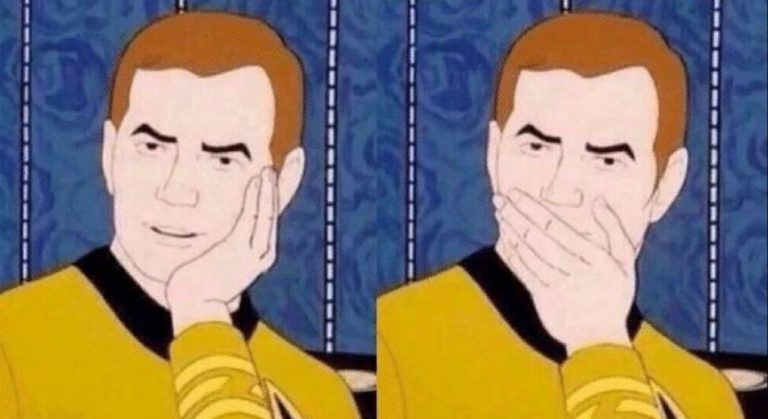
Both moments are taken from Albatross, the fourth episode of the second season of Star Trek: The Animated Series, which aired in 1974. Near the end of the episode the captain reacts to yet another squabble between Spock and Dr. McCoy. In the adventure plot this is a brief reaction to a familiar argument between comrades, while in a standalone image the movement of the hand looks like carefully performed surprise. For the meme, what proved useful was precisely the gap between the gesture and the almost unchanged face.
One of the notable early meme posts appeared in r/BlackPeopleTwitter on November 4, 2015. It described a person who knows an awkward secret but has to look surprised when told about it. During the same month the image also turned up on Twitter. These dated examples show a wave of spread, but they do not prove who first thought to turn Kirk's scene into a sarcastic reaction.
Double reading
In both panels Kirk stands before the same blue background, in a yellow uniform with a black collar and the Starfleet insignia. On the left a palm supports his cheek; on the right it covers his mouth. His brows stay furrowed, and his eyes do not widen into dramatic horror. There is no visible second participant in the conversation between the frames; their remark, secret or unexpected news must be supplied by the caption.
The transition from a bored pose to a covered mouth depicts an instant 'surprise,' but the expression stays too restrained to be believed as a real sensation. That is why the template works for sarcasm. The left panel can signify anticipation of banality, the right a feigned reaction to its announcement. The two parts should be read left to right; if the captions are swapped, the intonation changes.
The viewer knows more than the interlocutor
The most precise plot for Kirk is structured as a small scene of pretense. A person is told about an event they already know about, but revealing their awareness is impossible or awkward. The left panel shows the pause of choice, the right the found conventional gesture: cover the mouth and pretend to gasp. The meme does not necessarily accuse the hero of deceit; sometimes it is only about polite participation in a story they are hearing for the third time.
A single caption above both panels usually explains the secret better than two independent messages. Then the movement of the hand reads as the development of one person's reaction. If, however, the left panel describes a banal fact and the right a loud conclusion drawn from it, the result is a joke about predictable sensation. In both variants, the restrained animation makes excessive surprise conventional and therefore especially noticeable.
Three cases of feigned surprise
'A friend says they're getting a surprise party, and yesterday I was buying them a cake.' Kirk has to hide his involvement, and the palm becomes a mask of awareness. Second example: 'Listening to a neighbor be surprised that the last candy is gone, the one I ate.' Now the calm pose holds back a small guilt, and the exaggerated gesture tries to disguise it.
For a family gathering, 'Grandma again announces that she has my childhood photo' will do. There is no secret left: the person knows the continuation by heart but keeps up the solemn delivery. This variant conveys polite play, not exposure. Each plot gives two levels of knowledge: the speaker is sure the story is new, the listener knows more. The viewer understands both and notices Kirk's poor acting.