Who is pictured
Nick Young is a professional NBA basketball player known for his time with the Los Angeles Lakers in the 2010s. In sports media he picked up the nickname Swaggy P. His public image includes an outspoken manner and a noticeably emotional presence both on and off the court, which partly explains why shots of him so often ended up online.
It's important to distinguish the sports figure from the joke itself. The meme isn't tied to any particular game moment or scandal. The shots are used purely as an image of emotion, and the basketball player in them functions as a public figure rather than as an object of ridicule.
Origin of the meme
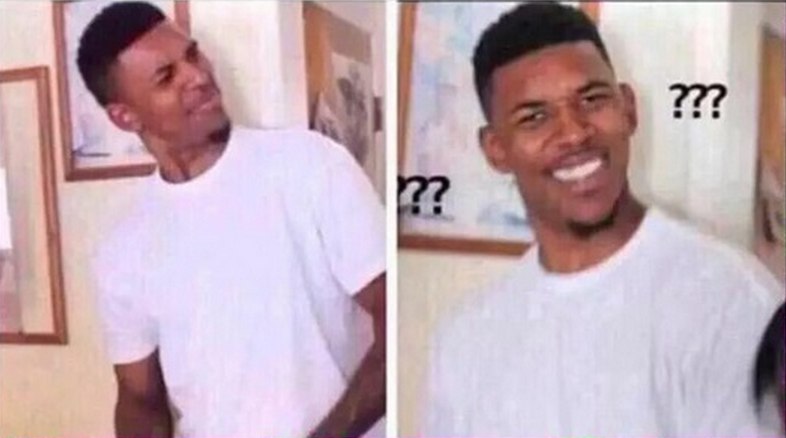
The meme took shape in 2014, when photos of the basketball player began circulating widely on social media. The two frames, placed side by side, created the effect of a reaction shifting: first a bewildered glance to the side, then a smile and question marks. The exact date of first publication, the author of the composite, and the original context of the shoot are not confirmed in open sources, so the editorial team relies on the year given in the entry and the general picture of its spread.
Part of its popularity is likely due to the fact that the combination of confusion and a smile reads clearly even without a caption. The question marks in the image work as a cue that's easy to add or swap out.
How the template works
The template is built on the contrast between bafflement and a self-satisfied smile. The first frame signals incomprehension, the second shows that the subject has already figured it out, or is pretending to, and that turns the situation into a joke. The format is handy whenever the reaction to an event is a mixed one: surprise, awkwardness, and an attempt to save face.
Users apply the picture to news that sounds strange, to texts where the logic breaks down, and to their own mistakes. The main condition is that the caption or context should highlight the absurdity of the situation rather than mock the people involved in it.
Variants and spread
In the Russian-language internet, the meme shows up most often in comments and short captions, where a quick response without a lot of text is needed. Sometimes other symbols or short phrases are used instead of the question marks, but the two-frame composition itself is preserved. Because of this, the template remains easy to recognize even once the original context has been forgotten.
Over time the meme became part of a general set of reactions understood even outside a sports audience. It's used by people who have never followed the NBA, which shows how an emotion can detach itself from the particular person who first displayed it.
Assessment and context
Ethically, the meme is harmless: it contains no insults, reveals no personal information, and isn't built on humiliation. That said, using real people as universal emotional images calls for some attention to the tone of captions. The template works best when the joke is about the situation rather than about the appearance or personal life of the person in the frame.