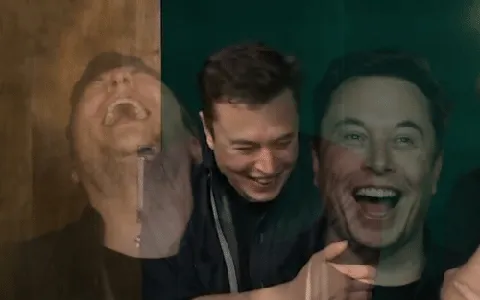
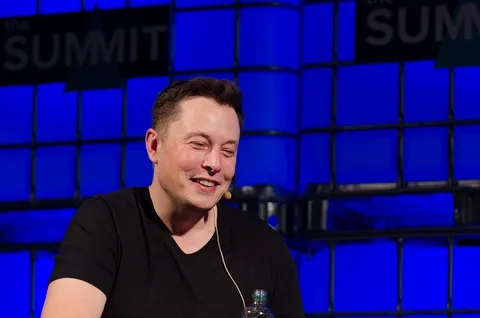
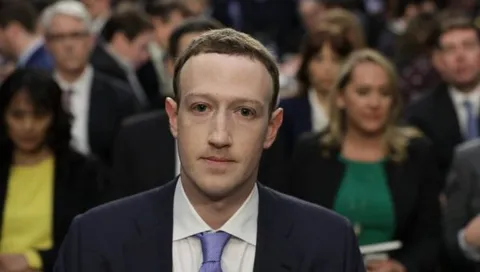
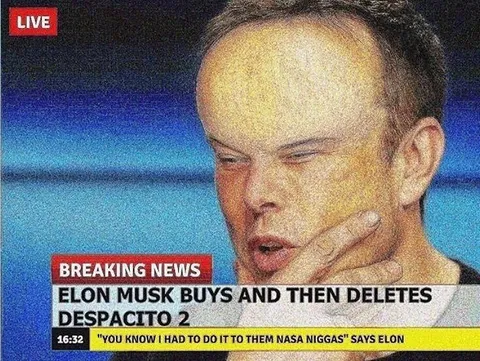
A portrait on a political background
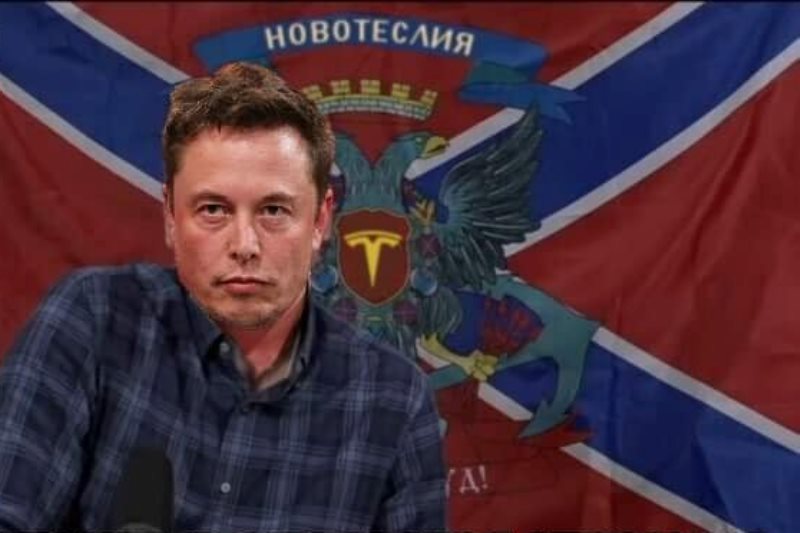
In the local image, Elon Musk is shown against a flag bearing the word "Novorossiya". This is a political montage, not a neutral photograph, and it does not confirm that Musk took a picture in such a place or formally endorsed the symbols shown. Captions in this series of memes usually refer to his public posts about Russia's war against Ukraine in October 2022.
At that time Musk posted several points on Twitter proposing options for a peaceful settlement, including recognizing Crimea as Russian and holding votes in the occupied regions under international supervision. These formulations provoked public controversy, including a response from Ukrainian President Volodymyr Zelensky. A meme may criticize or parody the specific proposal, but one should not attribute to the image's author an official role as negotiator or pass the montage off as a historical document.
This composition is easily read as a statement because of the recognizable face and the specific emblem in the background. So if a reader might take the montage for a news photo, it is worth calling it a photoshop outright. The visual contrast works for a conversation about public rhetoric, but it is not an independent source of information about the status of a territory.
Why the discussion became a meme
Musk's posts combined the influence of a major entrepreneur, international politics and the format of short online polls. Users reacted to the mismatch between the complexity of the war and the way a solution was proposed on social media. Photo montages reinforced this impression by visually placing the author of the post inside a political scene or next to its symbols.
That is why the same template could express mockery, indignation, distrust, or simply fatigue with sudden expert plans. The image itself does not show what Musk thought about a particular territory beyond the words he published; it only marks the topic. For accurate coverage it is better to refer to dated public statements and call the proposals his proposals, rather than claim that he "decided" or "handed over" a territory.
Examples for discussing loud advice
"When you were asked to help choose a series, and you drew up a four-point plan with international supervision." This parodies the scale of the answer to a far simpler question. "The family chat asked where to order pizza; the expert has already proposed revising the delivery borders." The second example uses political vocabulary as deliberate hyperbole, without reproducing any real conflict.
For a more serious caption you could write: "One post, and half a day goes on arguing over who has the right to propose terms at all." This describes the public debate without attributing motives. The examples were invented for this article and are not quotes from Musk. In political conversation it is useful to mark which part is the joke, which is a quoted proposal and which is the author's own assessment.
Accuracy and visual context
Keep the face, the symbolic background and the caption visible enough for the reader to understand the topic. But if you rework the image as a news illustration, state that it is a photo montage. Do not add geographic labels or official emblems absent from the original, and do not present the scene as documentary proof of a person's connection with a political organization.
The image is tied to a full-scale war, so even an ironic treatment can hurt people for whom the conflict is not abstract. It is safer to joke about the overconfident tone of online proposals or about how a complex topic is discussed, without turning civilians' suffering into a punchline. The wording should make clear that this is a meme reaction to the 2022 posts, not a survey of all of the politician's views.