What is visible in the frame
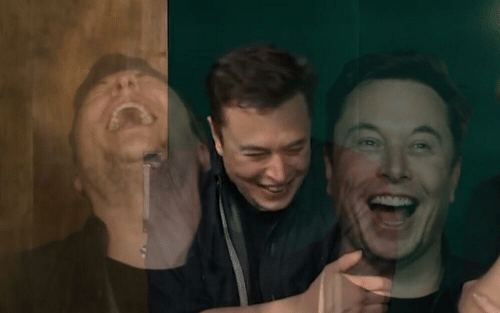
The picture is a montage of three overlaid frames. In the center, a dark-haired man in a dark zip-up jacket laughs with narrowed eyes, looking down and to the right; his hands are visible at the bottom. On the left, a second image shows through semi-transparently: the head is thrown back, mouth wide open. On the right, a larger laughing face is laid over the background. The background is brownish on the left and dark green on the right.
There is no deer in the shot. The frame shows a reaction rather than an event, so the meme's meaning rests on the caption and the context of the episode. The repeated overlay of laughter strengthens the impression that the person cannot stop, and the frame works well as a template for the emotion of 'funny and a little awkward.'
The Meme Review episode
The episode aired on February 22, 2019, on PewDiePie's YouTube channel. It was a Meme Review episode with guests Elon Musk and Justin Roiland, one of the creators of the animated series 'Rick and Morty.' The format is simple: the hosts take turns watching a selection of memes, rating them and joking.
Musk's appearance in this format was noticed in advance: on January 27, 2019, he himself asked on Twitter whether he should host a Meme Review episode. A light, unofficial conversation without businesslike phrasing made the scene stand out, and viewers started posting clips from it.
The dead deer and the question
The episode's last meme, according to descriptions, showed a dead deer at the bottom of a pool. Musk reacts with a fit of awkward laughter and asks in English, roughly: 'Oh my God, is that real? Did that actually happen?' This exact reaction became the basis of the meme: laughter mixed with surprise and awkwardness.
The segment with Musk and Roiland in the full episode begins at about the 13th minute. The meme's meaning is tied to that scene, so it is worth remembering that the deer itself stays off-screen: jokes most often use only the face and the laugh.
Captions that hold up on a pause
'A colleague wrote that the bug is fixed. I laugh and ask: is that really true?' This example moves the reaction from the show into a work situation: laughter becomes the first defense against news that is too good.
'The client asked if we'll deliver on Friday. Laugh, then a pause and the question: are you sure?' Rhythm does the work here. First comes the laugh, then a short pause, and only after it the skepticism, which is what makes the line funny.
'The testing report found a deer in the pool. Is that not a bug, but a feature?' The absurd detail supports the joke, and the question 'a feature?' replaces the obvious answer with an ironic guess.
When to use it
The template suits situations where you need to show disbelief at news that is too strange: an unexpected report, a fantastical plan, a dubious story in a chat. The emotion on the face reads instantly, so the caption can be kept short.
Over time the frame spread across social media without any link to the deer: users cropped the image, added their own captions and used the reaction for any situation where news seems too unbelievable. The meaning has since shifted from the specific scene to a general feeling of disbelief.
The meme describes a reaction to a scene, not the views or actions of Musk himself. A caption should not attribute to him words or motives that are not in the episode: the joke works only as an emotion that the viewer tries on for themselves.