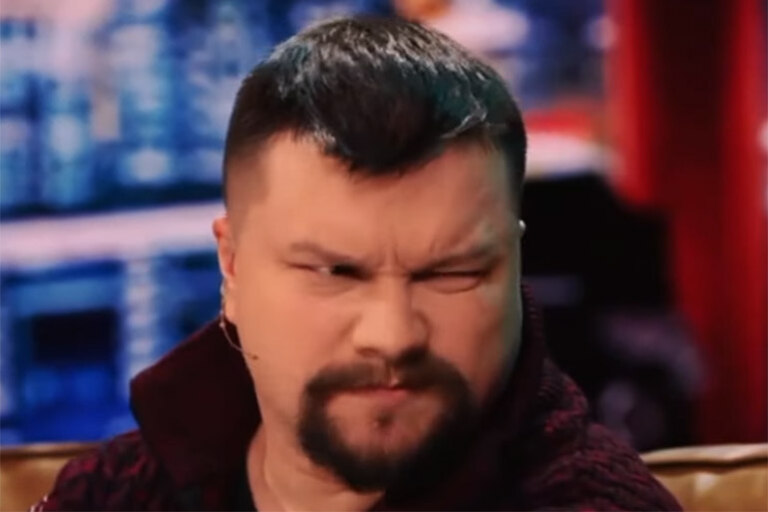
A squinting guest in a burgundy sweater
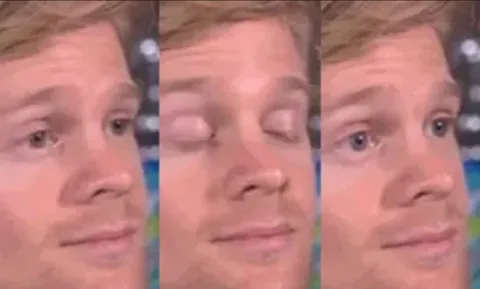
The frame is a close-up from a TV studio. A man with closely trimmed temples, dark hair and a beard, in a dark burgundy chunky-knit sweater. He squints hard, brows knitted, lips pursed: the face is caught in the moment of speaking. The background is blurred: blue city lights and the red frames of the set. It is neither a staged photo nor a collage but a frame from the recording of the show, cropped at the shoulders.
The facial expression is what made the image suitable for memes: it already reads as “I’m not going to discuss this.” What is absent from the frame also matters: there is no caption and no arrows, so any text can be placed on it.
Shou Voli: Sobolev’s question and the answer by syllables
The phrase was spoken on the program “Shou Voli” (“Volya’s Show”, a talk show) on the TNT channel. The guests of the episode, released in late April 2025, were the TV host Roza Syabitova and her son Denis. The conversation turned to age differences, and the co-host Ilya Sobolev asked the guest which age of woman he found more interesting to talk to, twenty or forty.
No answer on the substance followed. The guest said he would decide himself, and to a follow-up question he repeated the same phrase syllable by syllable, drawing out the last sound. Roza Syabitova suggested moving on to the next question; no specifics ever appeared.
Later Ilya Sobolev said he had not expected this exchange to be left in the edit. Roza Syabitova also reacted publicly to the meme: in the summer, together with the singer Stas Kostyushkin, she recorded a humorous video repeating the same scene.
Why repetition turns an answer into a refusal
The humor is built on a mismatch between the question and the reaction. The question is simple and allows a short answer, but instead comes a formulation that tells nothing. Repetition strengthens the effect: the first “sam reshu” can still be taken for a slip, the second is already a demonstrative refusal to take part in the conversation.
The arrangement of roles works too: the host presses for specifics, the guest answers ever more briefly, and a third participant of the scene steps in to change the subject. Such a scheme is easily carried over to an everyday situation in which one person has to answer and the other does not want to.
The disputes around the episode are a separate part of the story. A considerable share of the discussion concerned not the joke but the relationships inside the family, and these were viewers’ guesses, not established facts. There was also a version that the host deliberately did not change the subject; it has no confirmation.
Where “sam reshu” is heard: the doctor, the waiter, the hairdresser
The short sound from the episode spread across social media: in summer 2025 hundreds of videos were recorded with it. Most often the phrase is put in the mouth of someone who is supposed to decide but dodges: a hairdresser who will pick the length himself, a doctor who will sort out the diagnosis himself, a waiter who will determine the doneness of the steak himself.
Another use is as a reply to a tactless question. Here “sam reshu” works as a polite but firm boundary: the asker gets neither a “yes” nor a “no”, and the conversation closes.
And a third case is a joke about oneself: the phrase is attributed to someone who puts off a decision but confidently declares independence. What is funny is the gap between the statement and the lack of result.
Captions: vacation, “have you eaten”, deciding in the moment
“Asked about vacation plans. Answered like an adult.” The caption works on contrast: the question demands specifics, and the answer provides none.
“Mom: have you eaten? Me: sam reshu.” A short everyday scene in which the phrase sounds almost out of place, and therefore funny.
“I’m not dodging, I just decide in the moment.” Here the hero’s line is presented as an explanation, and the explanation explains absolutely nothing.
Where the text goes in the frame
The frame works as a reaction, not as a standalone picture. The text goes on top, where there is empty space and a blurred background. The interlocutor’s question reads in the first line, the phrase itself in the second, larger.
In a two-part format, the interlocutor’s question is placed on the left and this frame on the right. Cropping on the face is more reliable than a wide shot: the squinting expression reads even on a small screen.
What is funny here is the evasive answer itself, not the guest’s personality: a caption built around the scene from the show lands more accurately than a personal attack.