The T-shirt and the room frame
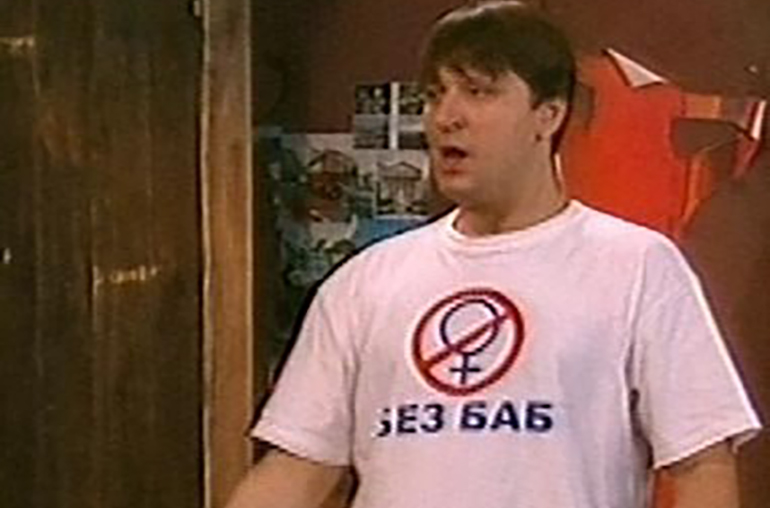
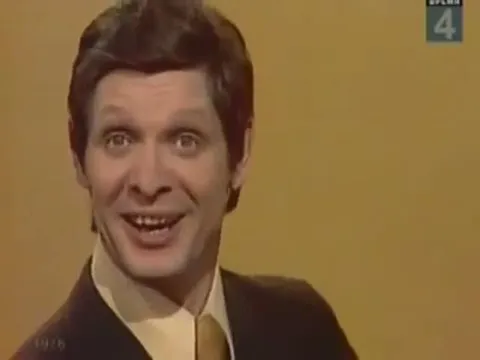
The frame shows a man in a white T-shirt with blue lettering “NO BROADS” and a red crossed-out female symbol above it. The first letter of the inscription is slightly cut off by the edge of the frame, but the words are readable. He stands in a room: to the left is a wooden door, on the wall behind him are colorful photographs, and a red object is visible on the right. His mouth is slightly open, and his gaze is directed to the side, as if he has just said something or is about to object.
The footage is from television, with the softness of image typical of old TV. The words on the clothing make the shot self-sufficient: the viewer gets the joke even without having watched the series.
What is known about the origin
The frame is attributed to the Russian comedy series “Happy Together.” Viewers remember the “‘No Broads’ society” among the show's memorable moments. Detailed information about which episode the T-shirt appeared in, who exactly came up with the idea, and how it developed in the plot is not confirmed, so any retelling of the storyline would be guesswork.
The date the phrase first appeared in memes is not reliably established. It is only known that the inscription is recognizable as a standalone frame and is used independently of the plot. This is a normal fate for many memes from series: the picture lives apart from the episode.
Why the phrase outlived the series
The phrase quickly separated from its context. It is used as a playful name for a closed chat among friends, as a call for a weekend “for our own,” and as irony toward any serious meeting. The meme rests on contrast: the slogan sounds loud and categorical, while the reason for it is usually trivial.
The meaning of the joke changes with the caption. Some use the phrase as self-irony, others as a parody of excessive seriousness, and still others recall the series. In every case the same thing works: the disproportion between a solemn motto and an everyday situation. It is the same mechanism as interest clubs with grand names and a tiny agenda.
Caption examples
Below are four invented examples.
“Club meeting. Agenda: who buys the juice, who takes out the trash, and why this is even being discussed.” A parody of a solemn protocol: a lofty register is applied to trifles, and the gap between form and content creates the laughs.
“The charter is written on a napkin. Clause one: no one is invited to the dacha without written confirmation.” The comedy here lies in the contrast between the existence of a charter and how pointless and bureaucratic it is.
“Membership fee: two pastries and a report on the past week.” Club paraphernalia is scaled down to a domestic level: joining is required, but it is laughably small, and this lowering of style is the joke.
“The club's motto is loud, but the decision was made in the bread line.” The joke is built on an abrupt shift: a grand slogan sits next to an ordinary scene, and the viewer fills in the contrast themselves.
How to read the joke today
The frame works best in a light ironic tone: as a reminder of an old series or as a parody of any closed circle with a pompous name. The irony is aimed at the club's seriousness and its absurd rules, not at people as a group.
If a caption sounds as though it seriously calls for excluding people on the basis of gender, it goes beyond parody and the frame loses its comic point. For a neutral caption, it is enough to show the contrast between a small occasion and a solemn motto.