What the frame shows
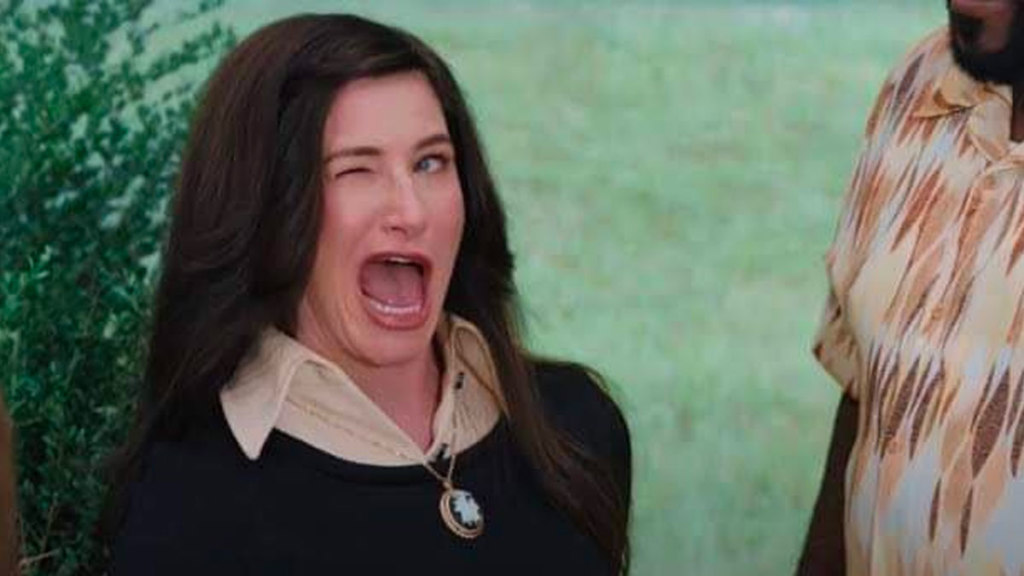
A close-up of a woman against a green lawn and bushes. She has long dark hair, a black sweater with a large light collar, and a pendant on a chain. One eye is squinted, the other wide open, and her mouth is open almost in a shout, but the expression is conspiratorial rather than frightened. At the right edge of the frame, the edge of another person's patterned shirt comes into view.
The facial expression is deliberately exaggerated: this is not a subtle hint but a wink that can be spotted from a mile away. The comic contradiction is what the whole image rests on.
Agnes from WandaVision
The frame is taken from the Marvel series WandaVision, where the character is played by Kathryn Hahn. In the story she first appears as the neighbor Agnes and only later turns out to be Agatha Harkness. The wink can already be seen in the trailer published on 10 December 2020, around the fortieth second, and then in the third episode, “Now in Color”, which aired on 22 January 2021.
The fan wave began even before the episode: on 9 January 2021 a journalist from an American newspaper posted a GIF of this moment on Twitter, and it collected hundreds of likes. These are among the earliest known examples, not necessarily the very first.
Why the look became universal
In the scene the character behaves as if she wants to hide something, but does so extremely clumsily. Viewers picked up exactly this tone. The wink became a sign of “I know you're lying, and you know that I know”, or, conversely, a sign that the speaker is lying brazenly and not hiding it.
The template left the fandom at the end of February 2021: reportedly, on 25 February a tweet comparing this moment to the principle of Chekhov's gun gathered tens of thousands of likes. Since then the frame has been used for open secrets, obvious excuses, polite lies, and situations where everyone pretends not to notice the elephant in the room.
Captions that work
The examples are invented for illustration.
“Two coworkers who both claim they've already read the email.” The wink turns an ordinary polite lie into a shared secret.
“Me: I didn't buy anything. Packages: arriving every day.” A contrast between the words and the obvious picture.
“Boss: this will be a quick meeting. Meeting: two more hours.” Here the look is a reaction to a promise that could never be kept.
“When you say you're just watching the show casually, and it's already the third season.” Self-irony: the person gives themselves away with the wink.
Usage tips
The template works best when the caption states what is said out loud, while the frame shows the subtext. If the caption already explains everything, the wink becomes superfluous. Keep the lie or omission harmless: a joke about everyday trifles comes across as warmer.
Chains of captions also work well: the same reaction under several everyday situations in a row, where each one is a bigger lie than the last. A short pause between the caption and the frame in video format also boosts the effect. Knowing the show is not required, since the facial expression alone is enough. But for those who watched WandaVision, the frame adds another layer, because behind the friendly mask the character really is hiding a different identity.