What's in the picture
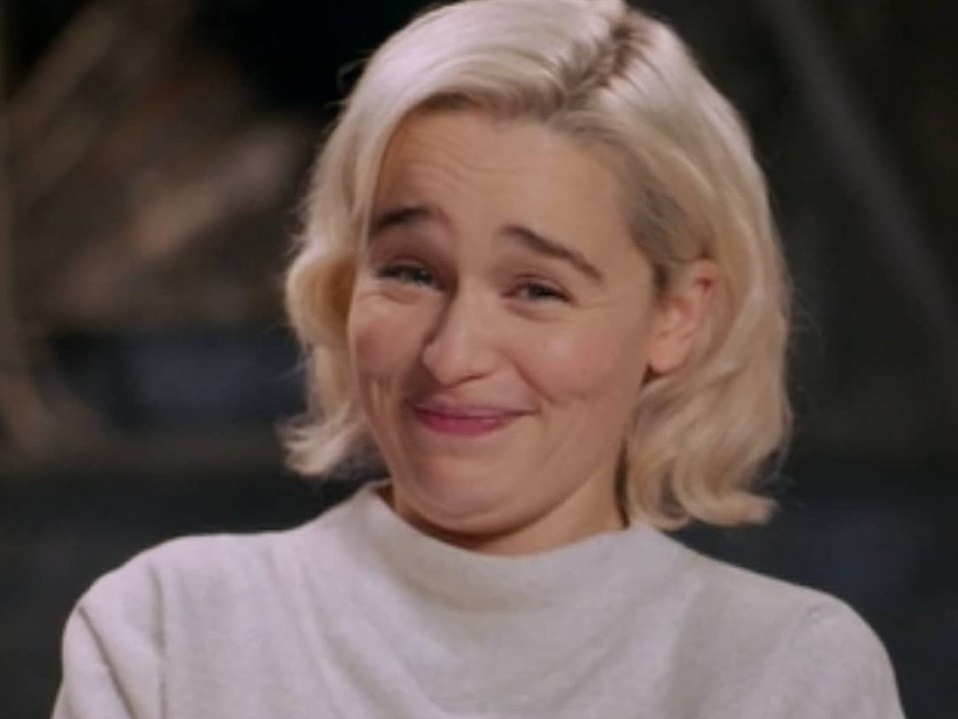
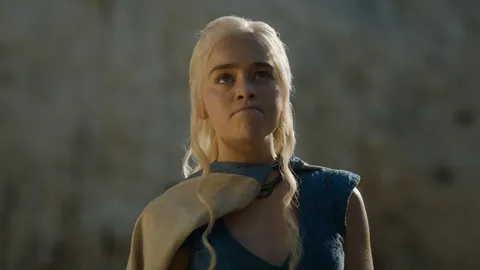
The frame shows Emilia Clarke, the British actress known for the role of Daenerys Targaryen in the series Game of Thrones. Her hair is light, cut in a short bob, and she wears a light sweater with a high collar. Her brows are raised, one eye is open more than the other, the corners of her lips are pulled into a tight smile, and her chin is slightly tucked in.
This is neither an open smile nor laughter. The face expresses doubt mixed with politeness, as if the person heard something strange but decided not to argue. The frame resembles a screenshot from an interview or behind-the-scenes footage: the background is blurred and the camera looks almost straight at her.
What is known about its origin
The exact source of the frame cannot be determined from the picture itself. It is probably a piece of an interview or promotional material, but the show's name and the recording date are unknown, so it is not wise to attribute the meme to a specific occasion.
The frame became recognizable thanks to the actress's career: Game of Thrones ended in 2019, and Clarke became one of the series' most famous faces. The meme nonetheless lives apart from the role and from any particular conversation, having turned into a universal grimace of disbelief.
How sarcasm works without words
A sarcastic reply is usually built on a gap between words and tone. Here there are no words, but the gap is created by the face: the smile says “sure,” while the eyes say “doubtful.” The viewer picks up the conflict of signals instantly.
Another device is the restraint of the reaction. The actress doesn't roll her eyes or laugh; she endures. A caption under such an expression takes on a tone of restrained irony that could not be conveyed with an emoji or text without extra explanation.
Caption examples
“Boss: ‘There's hardly any work, you can leave early.’” The reaction shows disbelief at a too-good-to-be-true promise.
“Friend: ‘I'll just pop in for five minutes’ (four hours later).” The meme captures the moment when the formula of politeness doesn't match experience.
“Ad: ‘This feature will save you tons of time.’” The smile conveys trust roughly the same size as the skeptic's.
“Me, to myself: ‘Starting a new life on Monday.’” Self-irony also fits, since here the disbelief is aimed at the author themselves.
Nuances of caption and intonation
The expression here is ambiguous: it is skepticism, awkwardness, and suppressed laughter all at once, and that is precisely why the meme is so flexible yet demanding of its caption. For sarcasm in text you need a line that makes one want to meet it with exactly that raised eyebrow and narrowed eye: an exaggerated promise, an overly smooth excuse, an excessively optimistic forecast. For awkwardness it's better to add a detail explaining why the heroine silently endures the situation out of politeness. Without a cause she seems to be reacting to, the frame turns into an ordinary, meaningless grimace.
How to use the template
The frame works best as a response to statements that sound too smooth: promises, excuses, advertising assurances. It is weaker where open aggression is needed: the expression is too restrained and soft.
A good caption is short and contains the very claim the heroine is reacting to. The device “words, then reaction” is stronger than retelling the situation. Keep in mind that the meme uses the face of a real person, so it's better not to tie captions to her personal life or beliefs.