The final episode and Bran's line
The line is spoken in the eighth season, in the sixth episode, “The Iron Throne.” Tyrion proposes that the assembled lords choose Bran the Broken as king, and Bran answers with a question that in the original reads “Why do you think I came all this way?” The Russian version that took hold in memes is “А зачем еще я проделал этот путь?”
The point is the hero's long road. After falling from a window in the first season, Bran ends up in a wheelchair, then travels north, beyond the Wall, to the Three-Eyed Raven and acquires new abilities. That is why the answer sounds not like a simple agreement, but like the outcome of the whole path that the viewer followed over many episodes.
Why the phrase became a joke
The line poses a question that does not need an answer. When a person has gone a huge distance, any decision looks obvious. That is why the phrase suits any story where long effort ends in something unexpected or mundane.
The Russian version is short and rhythmic, and the word “ещё” (“still/else”) gives it a light smirk. The intonation of a question makes the caption sound like an answer to a question nobody asked, and this is exactly what turns the line into a universal template: it can be inserted into any story about a long journey with an unexpected ending.
What is visible in the frame
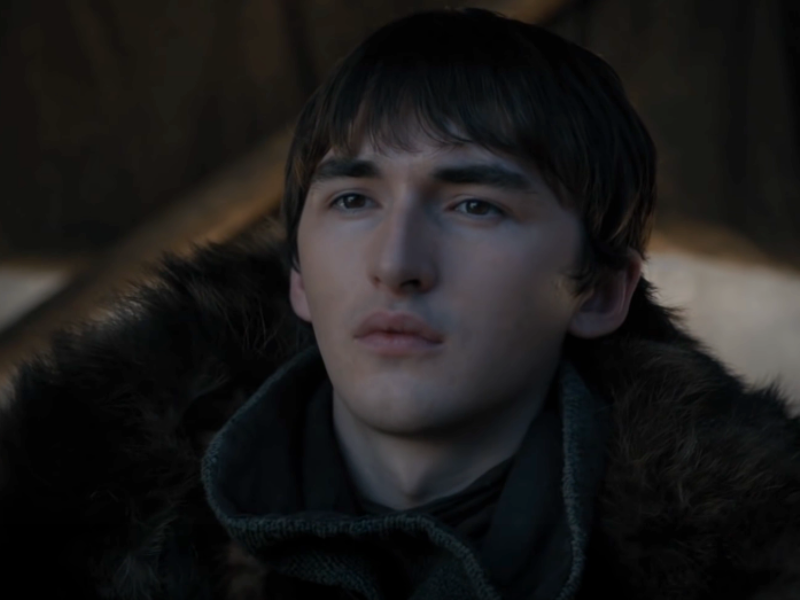
The picture is a close-up of a young man with dark hair and a fringe falling onto his forehead. His brows are slightly drawn together, his lips are closed, and his gaze is calm and directed a little to the side. He wears a dark fur collar and a knitted gray-green neckline around his neck.
The background is dark and blurred, with warm brown tones visible on the right and left, resembling wooden beams. There are no captions in the frame. The character is Bran Stark, and for the joke what matters is the hero's role, not the person on the screen. The impassivity of the face strengthens the meaning of the phrase: he seems to have decided everything long ago.
Three caption examples
The examples are built on a long backstory and a modest outcome.
“I rode for half a day to the dacha with two transfers, and my mother-in-law asks for help with the garden beds. Why do you think I came all this way?” The long backstory gives the phrase weight, and the small request turns grandeur into an everyday scene.
“I studied for six years to be an accountant, passed everything, and then the boss asks whether I'd like to move to sales.” The irony lies in the abrupt transition: the effort is enormous, and the next step looks almost random.
“Walked to the store across the whole neighborhood, and the cashier says the bags have run out.” The pause between the long road and the small disappointment makes the caption funny. The hero's serious face heightens the contrast.
How not to overdo the template
The template works best when the caption really involves a path: a trip, a long project or a trial. Then the phrase sounds like a conclusion. If the path is short, the effect disappears, and for short situations it is better to pick a different frame.
The line is taken from a TV series, so it is worth rewording it in a way that keeps the connection to the plot clear. If the caption simply repeats the quote without new meaning, the joke quickly fizzles out. It works best when the last line of the caption is exactly the one the hero says, and everything else prepares the ground for it.