What's shown in the picture
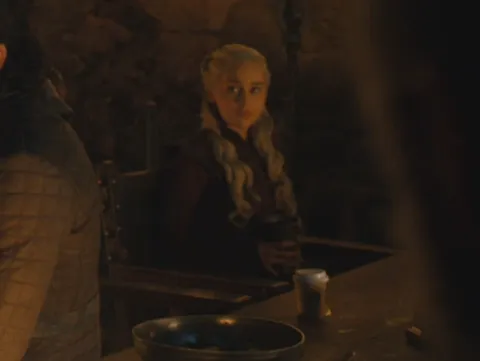
The frame captures Daenerys, played by Emilia Clarke: her blond hair braided, wearing a sleeveless blue dress and a cream-colored cloak, against a backdrop of a sun-bleached sandy landscape. Her face is twisted into a grimace: her lips are pulled into something like a drawn-out whiny sound, her eyelids are nearly lowered, and her head is tilted slightly. It's exactly the contrast between the queen's usually stern, majestic image and the exaggerated mocking expression that creates the comic effect.
In the classic version, the macro consists of two frames. The top one provides the context: usually the other party, or a caption, stating a request, an annoying proposal, or a pompous claim. The bottom frame with Khaleesi serves as the reaction. The heroine seems to copy the tone of the person making the request and shows just how naive or tiresome their words seem to her. That's why the picture itself works as a tone-of-voice commentary, and text inside it is barely needed.
Origin and history
"Game of Thrones" premiered on HBO in 2011, and from the very first season Daenerys became one of the key figures of the story. The nickname "Khaleesi" is the title of a leader of the nomadic Dothraki people, and in both English- and Russian-speaking communities it stuck to the character as an affectionate or ironic name.
The specific episode the frame is taken from, and the author of the two-panel macro, are not known, so a specific creator of the template can't be named. The format gained traction in Russian-speaking communities around 2016. At that time, reaction pictures featuring characters from popular shows had become a routine tool for comments on social media and in messengers.
Like many macros of this type, the picture spread not through official channels but through reposts, forwarding in chats, and themed communities, where users added their own captions. The template quickly broke away from the show's original context: a viewer who's never watched "Game of Thrones" still reads the heroine's expression and understands she's laughing at someone.
How the meme is used
The typical setup is this: the top portion or the caption describes a request, a pushy proposal, or a pompous statement, and the bottom panel with Khaleesi answers with a silent mocking impression. Sometimes no text is needed at all, and then the picture serves as a reply to an entire message, like a line in a live conversation.
Captions are usually built around an ironic refusal or mockery of the other person: "asked me to take out the trash," "suggested we take a course together," "said everything would be fine." In these situations Khaleesi mocks the person making the request, showing that their request doesn't seem serious, and that the request itself looks a bit silly.
The format is also used for self-deprecation. A person might depict how their own "I told you so" comes across from the outside, or comment on someone else's post that seems overly solemn to them. Thanks to this flexibility, the template has a long life and regularly shows up in comments under news posts and in message exchanges.
Why the meme works
The main reason for its popularity is the character's recognizability. Daenerys holds a prominent place in mass culture, so a single frame is enough for the reader to grasp the context without explanation. The meme also leans on the genre of reaction pictures, where emotion matters more than plot: the viewer doesn't need to know what's happening in the episode to read the grimace.
The comic effect arises from incongruity. The heroine, who on the show looks like a formidable ruler, here acts like a sulky teenager mocking someone else's request. The shift from majesty to grimace draws a smile precisely because the viewer remembers what the character is like at other moments and sees how unexpectedly she's playing a different role.
Finally, the format is convenient because it needs no explanation: sarcasm is conveyed through expression, not text. That's why the template is easy to apply in different situations, from jokes about other people's requests to ironic replies in private messages. It remains understandable even to those who haven't watched the show in a long time, and it's precisely this ease that secured it a place in everyday internet language.