What is visible in the picture
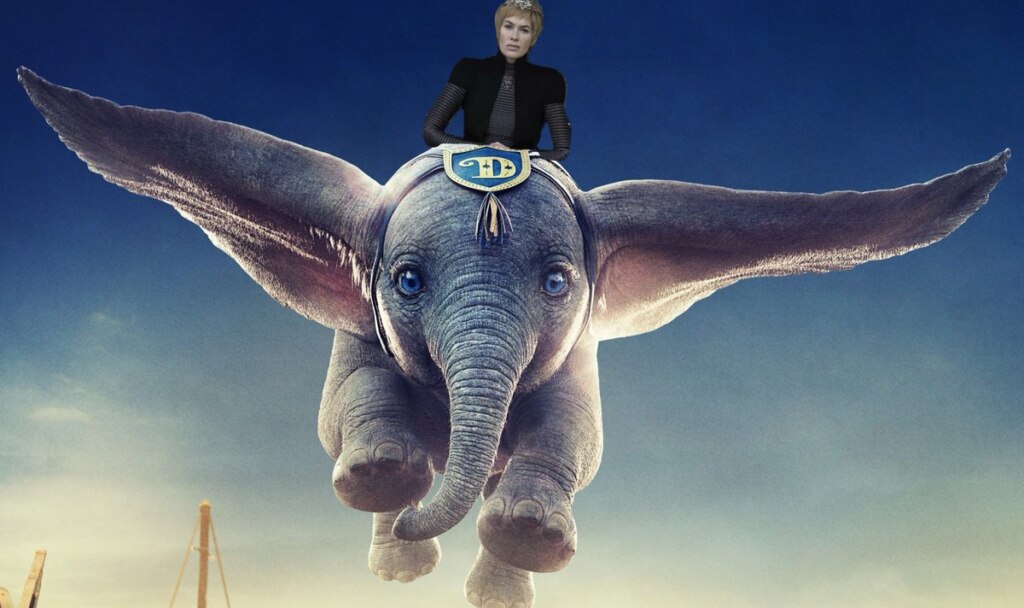
The frame shows a blue sky lightening toward the horizon, and at the lower left a wooden mast is blurred. In the center flies a gray baby elephant with very large, widely spread ears and blue eyes. On its head is a blue chest harness with a golden pattern and the letter D, with tassels hanging from it.
Riding the baby elephant is a woman in black clothing with a high collar and a thin light band in her short light hair. The figure is pasted into a ready-made frame: the silhouette edge and lighting differ from the elephant's, so this is a photomontage, not a scene from the series.
The elephant in the picture is Dumbo, the flying elephant from Disney's live-action adaptation released in 2019. The author of the montage is not established.
The episode the joke grew from
The line about elephants is tied to season eight of “Game of Thrones,” which aired on HBO in spring 2019. In this season Cersei relies on the mercenaries of the Golden Company, and elephants come up in conversations about them.
Elephants never actually appear on screen, and the heroine returns to this topic several times. Viewers took it as comic obsession, so the line quickly became a separate source of jokes. Exact wording in translations may differ, so captions should rely on meaning rather than a word-for-word quote.
How the series emerged
The first posts with this joke appeared soon after the season aired, but the exact date and the author of the first edits are not established, so the meme cannot be attributed to any one person.
The series grew fast: the heroine was placed into other frames, and the elephants were swapped for other animals and objects. The Dumbo version turned out to be one of the most vivid, because it adds a fairy-tale image to the “waiting for elephants” idea.
Such montages rest on recognition: a viewer only needs to know one line of the character and one image of an elephant to understand the joke instantly.
Caption examples for your own version
Below are four captions written for this template. All repeat one scheme: the heroine demands a specific missing thing and keeps coming back to it.
“The courier wrote that it'll be here in an hour. Where are my elephants?” An ordinary delay turns into a demand from the series. The scale of the request clearly doesn't match the occasion, and that gap is what's funny.
“They promised the renovation would be done by Friday, and it's been dragging on for months. Where are my elephants?” The elephants serve as a yardstick for what was promised and not delivered: the longer the job drags, the more absurd the demand for a missing giant animal sounds.
“The trip was supposed to be to the sea, and I'm still waiting for the elephants.” The caption uses the plot obsession as a habit: the heroine won't let go of the detail even when the overall plan has already failed.
“My coach promised I'd run a marathon by spring. Where are my elephants?” A specific missing thing instead of a sports result: the promise has long been forgotten, yet the demand still sounds just as confident.
In all four captions the text sets the missing item, while the picture shows a person who can't let it go. The more serious the caption's tone and the more absurd the object, the stronger the contrast.
How to use the template
The template suits jokes about drawn-out promises: delivery, repairs, a plan that keeps getting postponed. The heroine is fictional, so the joke targets the situation, not a real person.
Don't caption the frame in a way that mocks the appearance or private life of real people, including the actress. As long as the caption rests on the situation, the template stays clear and harmless.