The frame: an upward glance and pressed lips
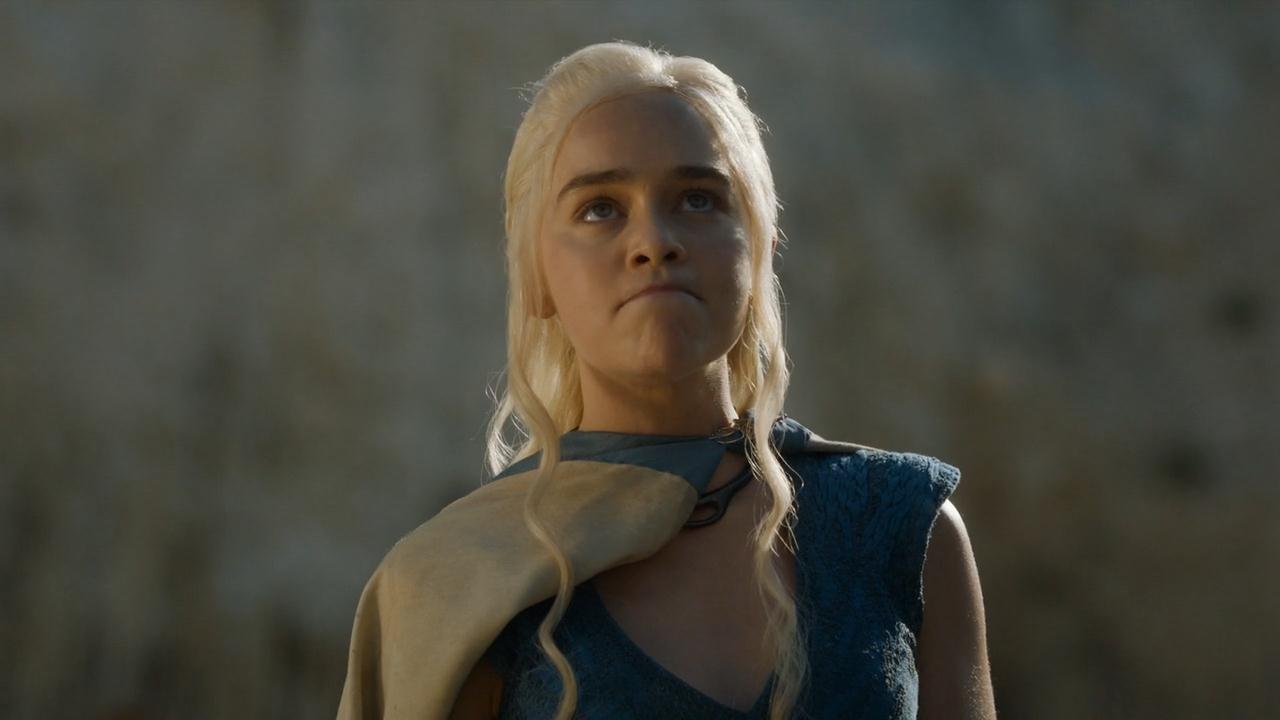
The picture is a close-up of the series character Daenerys Targaryen. Her light hair falls in waves over her shoulders, she wears a blue dress with dark trim at the neckline and a light cloak thrown over one shoulder. The background is blurred and in a warm brown tone. The main element of the frame is the face: she looks upward, her brows are drawn together, and her lips are pressed tightly shut.
This is an ordinary still from an episode, with no captions. The season and episode number cannot be determined from the image itself, so it cannot be claimed which exact episode is shown. The title “Khaleesi Is Annoyed” conveys the mood, but the picture itself shows restrained exasperation or thoughtfulness rather than open anger.
Origin: what is known and what is not
The series aired from 2011 to 2019, and Daenerys's image became one of the most recognizable on the internet during that time. The word “Khaleesi” is a title from the invented language of the Dothraki, a nomadic people; this is how the series refers to her. That is where the picture's title comes from.
The history of this particular frame as a meme is not established: there is no verified information about its first publication, its date, or the author of the caption from which the title grew. It is therefore more honest to treat the picture as a frame from the series that is used as a reaction, and not to attribute an invented backstory to it.
What the expression conveys
The meme works as a reaction to someone else's remark that one does not want to comment on out loud. The upward glance reads as “well, what now?”, and the pressed lips show restraint. The viewer picks up exactly this mix: the person is not shouting or being rude, but is clearly irritated.
The expression fits everyday situations: a drawn-out exchange of messages, an awkward question, or a request to do something that has already been discussed. The humor lies not in the plot of the series but in the mismatch between the majestic image of the character and a very mundane reason.
When the picture fits and when it does not
The frame works best where the conflict is small and comical: an argument over who forgot to turn off the light, or yet another question that has already been answered. Serious quarrels and other people's misfortunes do not suit it, or its lightness disappears.
Do not attribute stronger emotions to the expression than it actually conveys. The frame carries restraint, so the caption should be quiet, without exclamation marks: this way the reader immediately sees the match between the words and the face.
Sample captions and how they work
Below are a few examples that can be used as a starting point.
“I already explained that the letter was sent last Wednesday.” The caption moves the reaction to a bureaucratic reason, and the upward glance reads as weariness from repetition.
“You asked whether it's okay without sugar, and I'm still thinking about the answer.” Irritation builds over a trifle, and the facial expression puts a full stop at the end.
“When they ask again to redo what has already been redone.” The contrast between the grandeur of the frame and the petty task creates a funny distance, and the reader fills in the situation for themselves.
“Oh sure, of course, done in one evening.” The short phrase leaves room for guessing, which is why it works even without a long context.
All the examples are built on one device: the frame sets the emotion, and the caption names the reason. If the reason is too serious, the joke stops being funny, so the situation must stay mundane.