A wedding where everything changes
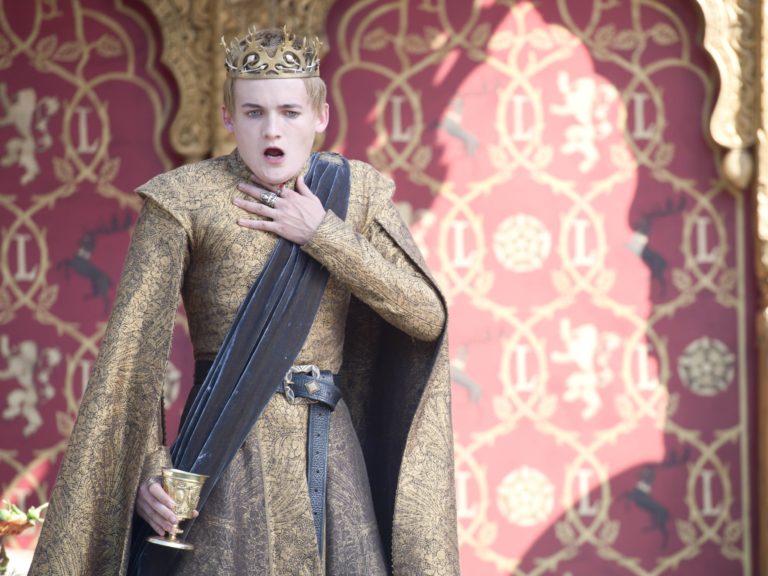
The image is connected to the second episode of the fourth season of “Game of Thrones,” “The Lion and the Rose.” The episode aired on April 13, 2014. During the wedding feast, Joffrey Baratheon is poisoned and begins to choke. The character is played by Jack Gleeson. Within the story, the gesture at the throat has a literal meaning and refers to the death of the fictional character.
Before this scene, Joffrey was used to ordering those around him and displaying power. The shift from confident behavior to complete helplessness makes the moment especially striking. For viewers of the series, the crown recalls not only his status but also the character’s nature: even a person who considers himself untouchable suddenly stops controlling what is happening. The meme takes from this breaking point a moment of shock.
A photo from the set
The reaction spread using photographs of the staged scene, not only stills from the episode. In this photo Joffrey stands alone in front of a red-and-gold patterned backdrop. One hand touches his throat, and the other holds a goblet. He wears golden clothing, a dark sash and a crown; his mouth is open and his gaze is fixed straight ahead.
The shot is wide enough that the gesture is not lost and close enough that the facial expression is readable. The goblet ties the image to the feast, although without knowledge of the plot it could easily be taken for an ordinary festive portrait. The famous scene explains the origin of the reaction but does not establish a separate date for the first meme caption on this photo. One cannot automatically assume that the episode’s premiere is the moment every macro was made.
From danger to everyday shock
In new captions the trigger is usually far smaller than the original tragedy. The viewer sees a person who seems short of breath from what they have heard and transfers this gesture to their own emotional reaction. The result is a vivid equivalent of “I have no words.” It can be indignation, unpleasant surprise or comic disbelief, not necessarily fear.
The royal costume adds a second layer. The hero looks too majestic for everyday worries, so an unexpected delivery fee or a pet refusing to obey gains an excessively high status. The meme also works for self-irony: the author presents their own shock as funny and out of proportion. At the same time, the caption must name a specific irritant; without it, the photo remains a dramatic scene with no clear cause.
Invented reasons to be left speechless
First invented example: “When the delivery costs more than the pizza itself.” The bill for food collides with the regal scale of outrage, and the goblet makes the hero look like a demanding guest. Second: “The schedule says ‘free slot,’ but it’s the gap between two tests.” The shock arises when a familiar phrase is clarified: rest turns out to be just the name of a break.
A third caption: “The cat looked at the new expensive house and climbed into the bag.” Here the royal offense conveys the owner’s reaction to crossed-out efforts. The picture itself does not prove the hero is angry specifically at the pet; it is a conventional role in a new plot. The shorter the trigger, the faster the gaze moves from words to the hand at the throat, which delivers the emotional climax.