The last conversation before the tears
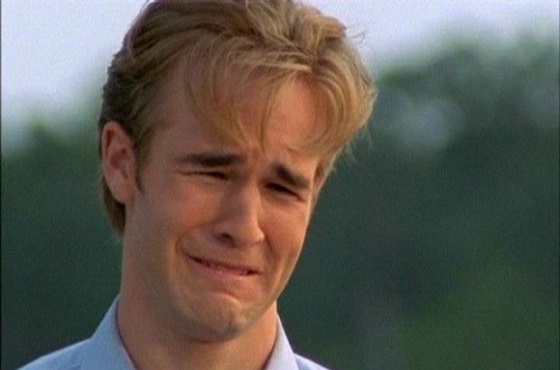
Dawson Leery, the character in Dawson's Creek, is played by James Van Der Beek. The source of the famous face is the third-season finale “True Love,” which aired in the US on May 24, 2000. Dawson tells Joey, played by Katie Holmes, that she should be with their mutual friend Pacey. When she leaves, he can't hold back and cries. In the character's story, this is a painful parting with hope, not a deliberately staged comic reaction.
According to Van Der Beek's recollection in a 2011 interview, the tears were not scripted in advance: the emotional moment arose during the performance. The actor found it funny that such a sincere feeling of the character was later used with the opposite intonation. This contrast helps explain the meme: the original power of the scene is preserved, but a new caption replaces the reason the character looks crushed.
The frame older than its meme fame
A clip with the crying face was posted on YouTube as early as 2006. In the late 2000s the freeze-frame appeared on blogs, gradually turning into an independent reaction. In January 2011, Van Der Beek took part in the Funny or Die project “Vandermemes”: he repeated the famous emotion and showed other facial expressions. Thus the performer joined a parody of his own television image, and the familiar crying received a new version.
This photo shows the original Dawson: light tousled hair, eyebrows drawn together, squeezed eyes and twisted lips. A light shirt is visible, with blurred greenery behind. Joey and Pacey are not in the frame, and there are no captions. The strong emotion is conveyed by the face itself, but the viewer can learn the reason only from the series or from the added meme text. The still freezes the crying at a particularly expressive moment.
A tragic face for everyday loss
The macro usually places a small occasion beside a reaction that would suffice for a heavy drama. A cooled dinner, a closed shop, or a failed attempt to save a game all receive an equally intense expression of pain. In the self-ironic version, the author understands that the cause is minor but admits that right now it feels enormous. Because of this, Dawson's face lets one both complain and laugh at the scale of one's own complaint.
There is also a sympathetic use. The picture can express sadness without a long story, especially in a conversation where the interlocutors already know the circumstances. The surrounding messages and the caption determine whether the intonation is ironic or serious. In GIFs, extra comedy comes from repetition: the short emotional movement returns again and again, as if the character cannot accept the same fact. In a still photograph, this effect is replaced by the recognizability of the grimace itself.
When the cause is smaller than the feeling
In a fictional example, a person saved the last piece of their favorite pie for the evening, then remembers they ate it at breakfast. The caption for Dawson reads: “A betrayal that cannot be passed on to someone else.” The strong reaction underlines the absurd struggle with one's own recent decision.
Another fictional scene: a viewer noticed a spoiler in the title of a video they planned to watch only a week later. A third variant shows a player who perfectly furnished a house but forgot to save the changes. Here the sadness remains understandable, though the scale of the television parting is clearly greater than the cause. The meme chooses a familiar exaggeration instead of a detailed explanation: one face is enough to convey how annoying it was to discover the loss.