Where the drawing came from
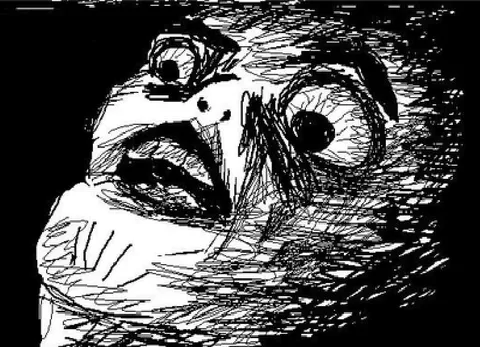
The meme belongs to the family of rage comics, which were mass-created and spread on English-language forums, imageboards, and social networks in the early 2010s. The drawings were done in a simple style: thick black outlines, flat colors, and minimal detail, with each face serving as a template for one specific emotion. The image that later got the caption "Cuteness Overloaded" conveys an extreme degree of tenderness: the eyes are open so wide they take up almost the entire upper part of the head, and tears run down the cheeks.
The exact author of the drawing and its first publication could not be established. There are no reliable sources that definitively tie the picture to a specific creator or date, so no artist's name is given here. Indirect evidence suggests that by 2011 the image was already circulating widely in English-language communities, and later moved into the Russian-language segment, where it got the name "mimimishechki." It grew out of affectionate baby talk: the word "mimimi" had become a term for everything touching and cute, and the suffix "-shechki" added tenderness and a light irony.
How the meme spread
The main spreading mechanism was reaction images in comments. A user would see a very cute video, a photo of a puppy, or a drawing and respond with this face, showing that they were literally disarmed by tenderness. Thanks to the simplicity of the drawing, the image was easy to adapt to any situation, and it stayed recognizable even when shrunk down, for example as an avatar or a small sticker.
The combination of the image and the caption played an important role. The word "mimimishechki" sounds affectionate and slightly ironic, so the meme is often used with a touch of self-irony. It captions not only sincere tenderness but also an excessive, almost staged reaction to things that seem too cute. In Russian-language community pages and chats it quickly became one of the basic reaction stickers that needs no explanation.
Variants and usage
Over time numerous derivatives appeared: messenger stickers, captions for photos of cats and puppies, reactions in games, and formulas like "the cuteness level is off the charts." This is the phrasing most often found in descriptions of the meme, since it precisely conveys the idea of being overwhelmed by emotion. The picture is sometimes applied to people too: to infants, to touching scenes in films, or to the unexpectedly kind acts of strangers.
The meme requires no knowledge of context and works as a pure emotional reaction. This explains its longevity: even years after it appeared, the face remains understandable and appropriate in messages, and the caption doesn't go stale. Unlike many memes tied to a specific film, video, or event, "mimimishechki" describes a state familiar to almost everyone, so it's easy to use even for people who never caught the first wave of its popularity.
Place in internet culture
The meme fits into the broader tradition of reaction images, where emotion is expressed through a hyperbolized face rather than through text. Rage comics became one of the internet's main visual languages in the early 2010s, then gradually gave way to photo reactions and GIFs. "Mimimishechki" outlived many of its genre neighbors thanks to its universality: it describes a feeling everyone understands, and the drawing is simple enough not to date technically.
The word "mimimi" itself took hold on the Russian internet as a term for everything cute: kittens, babies, soft toys, and the small things of everyday life. This habit of speaking affectionately about cute things cemented the meme in the speech of users of different ages, and today it's often used without any tie to rage comics, as a ready-made word for expressing delight.
Conclusion
"Mimimishechki" remains one of the most stable reaction images of the Russian-language internet. Its history shows how a simple drawing with a caption can become part of everyday speech: to understand what the tears of tenderness and the hands pressed to the face mean, you don't need to know the author, the date, or the original context.