Scene and character
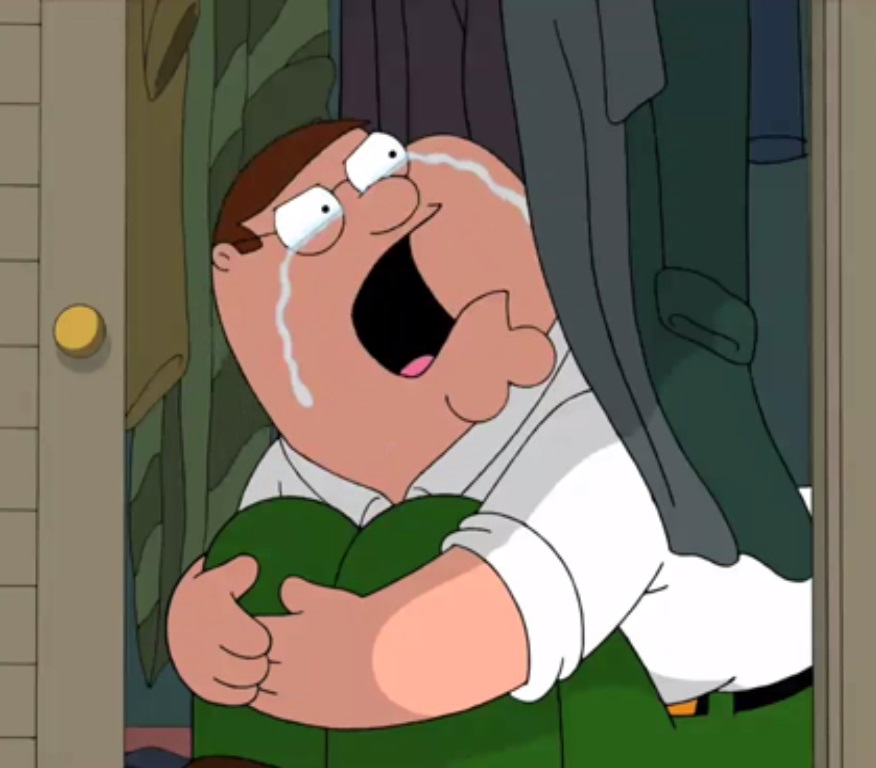
“Family Guy” is an American animated series that Seth MacFarlane created for the Fox network, and it premiered in 1999. Peter Griffin is the head of the family, and his character is built on impulsiveness, naivety, and sharp mood swings. In the frame he stands by a closet door with his mouth open, tears streaming from his eyes, and he presses a green object to his chest. His white shirt and green pants stand out against the dark clothes inside the closet. This kind of emotional delivery is typical of the show: the character pushes his reaction to the limit, and the viewer reads it instantly.
Why the frame is recognizable
The tears, the wide-open mouth, and the pose read without any sound, so the picture works as a reaction even without a caption. The character's face expresses an extreme degree of despair that is easy to transfer to any situation where a person wants to be left alone. The frame does not require knowing the plot: it is enough to understand that the character is crying because he has been pushed too far. That is why the meme is used across many threads of conversation, from jokes about work to everyday arguments.
The “Oh, just shut up already” caption
The meme's main strength lies in the contrast between the pitiful look and the sharp phrase. It sounds like a command, and it is hard to read unambiguously: it can be aimed at the other person or at oneself. In this way the picture ends up being both sympathetic and irritated. Examples of captions: “When people have been arguing about pizza in the chat for the fourth hour” and “The kid has asked for the sixth time why the sky is blue.” Both versions use the same reaction: the character can't take another repetition and snaps at the phrase, and the reader immediately understands that the situation has been dragging on.
Origin of the frame and the caption
The frame is taken from “Family Guy,” but the specific episode is not known. It is also unclear when Russian-speaking users first linked this scene to the phrase “Oh, just shut up already.” The caption may have arisen as a free-form line rather than an exact quote from a translation, so it cannot be claimed that the phrase is said verbatim in the series. What is reliably established is only that the image belongs to the series, and the caption belongs to the Russian-language tradition of the meme.
How the meme is used
The picture is most often posted in reply to a message that feels drawn-out or intrusive. It suits arguments, long recaps, and endless clarifications. The addressee is usually not named, so the meme does not turn into harassment of a specific person. The character experiences a strong but comic emotion, and the joke rests on his exaggerated reaction rather than on mocking someone else's misfortune. That is why the frame remains a universal tool for a quick reaction in conversation.
Place in the catalog
The meme dates to 2012. For that period, it was typical to use frames from animated series as ready-made reactions on forums and in communities. The first publication of the caption cannot be named. The meme has survived because of its simplicity: one frame, one phrase, and a clear conflict between emotion and command. That is enough for it to be understood by both a newcomer to the internet and a viewer who knows the series only from a few episodes.