Contents
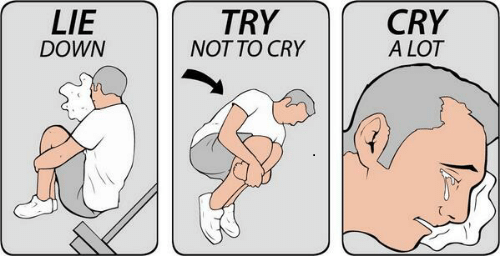
The comic consists of three panels with large captions that read like a step-by-step instruction. In the first panel, a man in a white T-shirt sits on the floor with his arms wrapped around his knees, and the caption reads LIE DOWN. In the second, he lies curled up with his face covered, captioned TRY NOT TO CRY. The third panel is a close-up of a face with tears running down it, captioned CRY A LOT.
The structure is built on escalation. Each step looks like an attempt to get a grip on an emotion, but the last frame flips the instruction: instead of advice to keep composure, it recommends crying heavily. The humor rests on the contrast between the serious form of an instruction and the everyday situation the panels imply. The poster-like typeface of the captions adds to the effect.
Image
The picture has three panels, the captions LIE DOWN, TRY NOT TO CRY and CRY A LOT, the figure of a man in a white T-shirt, and a close-up of a face with streaks of tears.
The composition is simple: three columns of roughly equal width, large type and contrasting colors. That is why the format is recognizable even in a thumbnail, where only the large words can be read. In later edits the top captions and the figure may have changed, but the basic composition stayed the same.
Origin
According to the meme page on an English-language site, the artist credited for the drawing is CollegeHumor artist Caldwell Tanner. The panel first appeared on September 10, 2010, in the article “Realistic Gym Workout Diagrams,” a set of parody posters for a gym. One of the posters showed a person in a fetal position with the caption “Lie Down. Try Not to Cry. Cry a Lot.”
The source does not explain whether this frame was a standalone joke or part of a larger bit, nor does it describe how the authorship attribution was established. The date of September 10, 2010, should be treated as the publication date, not the date the drawing was created.
Spread
The panel stayed relatively obscure for about two years. Noticeable growth began at the end of 2012, when imageboard users started making edits: the figure was replaced with characters tied to specific fandoms and with recognizable people, while the captions were kept. These versions spread faster than the original, since each one was aimed at recognition within a particular circle of viewers.
On March 5, 2013, the entertainment site Mandatory published a selection of the edits, after which the format spread beyond imageboards. Further distribution went through Tumblr, where users reposted and remade the images, adding their own characters and lines. By August 2017, the number of uploads with the corresponding tag on one of the meme archives exceeded 9,400.
Dating and meaning
The catalog lists 2012. This corresponds to the beginning of mass distribution, but not to the date the panel was created, which appeared in 2010. The text separates these two events so as not to conflate the publication of the original with the wave of edits.
The value of the format lies in the fact that it became a convenient frame for expressing emotions through a parodic instruction. The comic allows you to laugh at both the advice to “keep it together” and your own sentimentality at the same time.