From doll to reaction
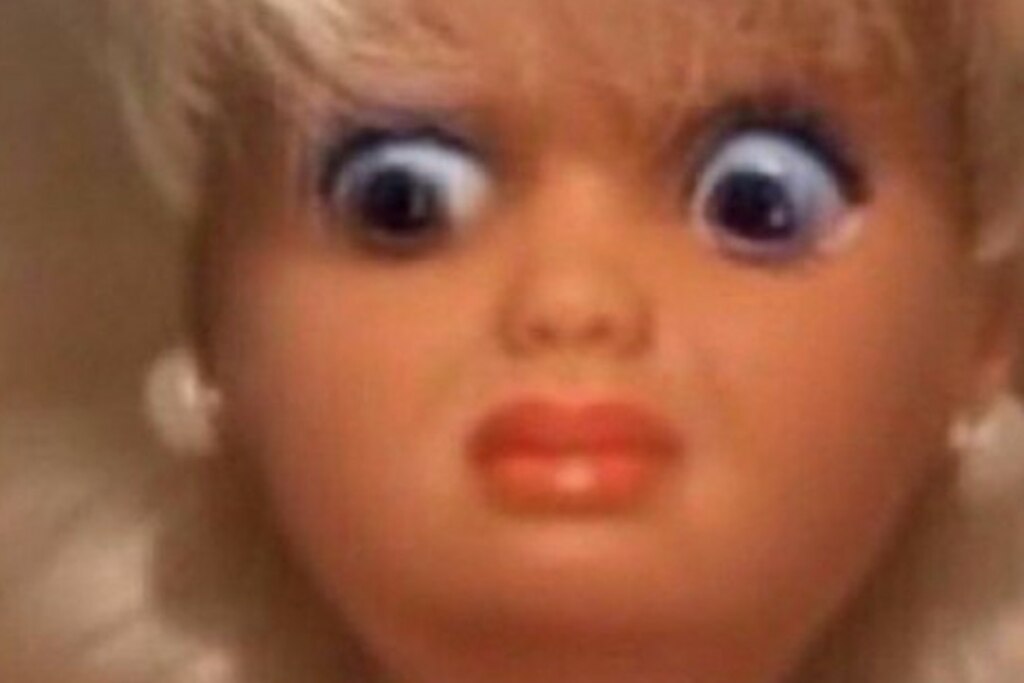
This is a grainy, heavily zoomed-in portrait of a doll: wide-open eyes, slightly open mouth, gaze aimed straight at the viewer. The camera is positioned low, so the face looks disproportionately large and expressive. Publications about the meme identify the doll as Mermaid Skipper with sea twins, released in 1993. The origin of this particular photo itself has not been established.
The image became a prominent reaction on English-language social media in the summer of 2023. One of the early viral posts used it as a response to news about an idea to give disapproving looks to smokers in Hong Kong. This history matters for understanding the joke: a photo of an expressionless doll suddenly took on the role of a person who isn't just surprised, but can't hide their distaste. The author of the original photograph and the exact moment the image surfaced remain unknown.
How the expression works
The meme doesn't require any particular text. It's enough to place the doll next to something that provokes sharp disapproval: a ridiculous piece of advice, a strange purchase, an overconfident claim. The gaze works as a short wordless retort. The doll's stillness helps too: the emotion looks frozen and therefore somehow stronger than an ordinary human reaction.
It matters that this isn't neutral surprise. The slightly open mouth could be read as bewilderment, but combined with the staring eyes it turns into disgust or a skeptical "ugh." The sender seems to be showing not their own face but a very theatrical mask. The joke reads better when the object of the reaction is specific enough; without context, the viewer just sees a strange portrait.
The shot deliberately doesn't give a precise answer as to what exactly outraged the character. That vagueness widens its use: the reaction is easily transferred from the original news story to a new episode, keeping only the tone. At the same time, the doll's face doesn't express subtle hurt or sadness, so those meanings shouldn't be forced onto it with a caption.
Original captions for "Barbie is disgusted"
"When a coworker says, 'I sent the file,' and it's a photo of their screen." Here the doll silently expresses the familiar mix of disbelief and exhaustion: the task got done on paper, but the result is clearly not it.
"Me, when the recipe says 'add a little salt' and someone dumped in half the bag." The caption turns a mundane mistake into a small moment of horror; the exaggerated reaction is what makes the scene funny.
"Saw a 'quick five-minute call' notification on the calendar for a two-hour meeting." Here the expression is aimed at a suspiciously optimistic promise. It's a good fit for a work chat, as long as the joke targets the situation and not a specific coworker.
When the meme fits
The template suits a short reaction to something obviously unpleasant, absurd, or dubious. It's convenient to send in a friendly chat when it would otherwise take words to explain why a suggestion sounds off. It's best to pick situations with no real harm involved and avoid attaching the doll to a person's actual photo: that way the target stays the strange decision or shared experience, not an individual.
You can skip a caption in a post if the context is already clear to the people you're talking to. If you do add text, it should name the specific trigger for the reaction rather than just repeating "I don't like this." The doll's sharp mask amplifies the point, so it won't suit a calm request or a serious conversation. In that case the meme risks coming across as mockery or an accusation.