Gibert amid the police chaos
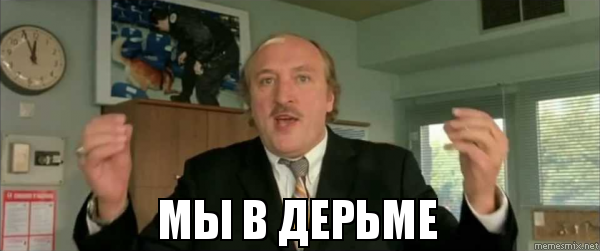
The picture shows Commissioner Gibert, played by Bernard Farcy, in a room with a clock and blinds. He has raised both hands and is looking ahead; across the frame, in large letters, is “WE'RE IN THE SHIT.” It is a still from the French comedy “Taxi 3” by Gérard Krawczyk, released in 2003. The film itself builds its comedy on a police chief trying to keep up his importance and order while everything around him goes wrong.
The Russian caption works as a standalone remark added to the facial expression and gesture. It doesn't need a long setup: the open palms recall the gesture of a person who has nothing to offer in their defense, and the look adds disbelief at the scale of the trouble.
An admission instead of excuses
The phrase sounds like a conclusion after several attempts to hold the situation together. It has no plan and no explanation of causes, only a general admission that everything is bad. That is why it suits a team that had only recently been discussing minor details and now discovers that the main part of the project isn't ready. Gibert in the frame does not look like a calm announcer: his raised hands make this short conclusion emotional.
The word “we” matters: the speaker includes themselves in the trouble along with everyone else. The line can be the group's self-irony rather than an accusation against one participant. Imagine friends gathering at a train station, each sure that another person has the tickets, and only at the closed turnstile does it turn out that nobody bought them. Here the collective admission is funny precisely because everyone made the same mistake.
From a big failure to small chaos
The blunt wording deliberately inflates the scale of the disaster. If edits disappeared from a shared document, a colleague might put Gibert next to the message “We sent the old version to the client.” If someone simply spilled tea, the same picture turns a trifle into a catastrophe. Between these versions there is a scale: the harder the mistake is to fix quickly, the more natural the phrase sounds; the more harmless it is, the more noticeable the exaggeration.
The scene is especially expressive when the trouble doesn't become shared right away. One participant notices that the plan failed, the others argue at first, and then they find the same problem in their own work. Then “we” describes a moment of synchronization: everyone has finally understood their position. Gibert's gesture fits this pause, because it both explains and throws up the hands.
A comic boss speaks for everyone
The frame adds to the line Gibert's character: this is not a neutral announcement but the admission of a person who is normally expected to give orders. The comic boss ends up inside the mess and cannot immediately regain control. So the phrase spoken on behalf of “we” sounds especially funny when it comes from the one who just assured everyone that they had foreseen every detail.
An invented variant: before a trip, a manager has assigned roles, drawn up a table, and appointed people in charge, but has left the folder with the tickets at home. The caption “We're in the shit” turns his reporting tone into shared bewilderment: the subordinates are no longer separated from the boss, they are stuck together by a closed bus. Here the joke is carried not merely by the failure but by the fall of an important figure from the position of organizer to just another participant in the chaos.