Elrond's memory scene
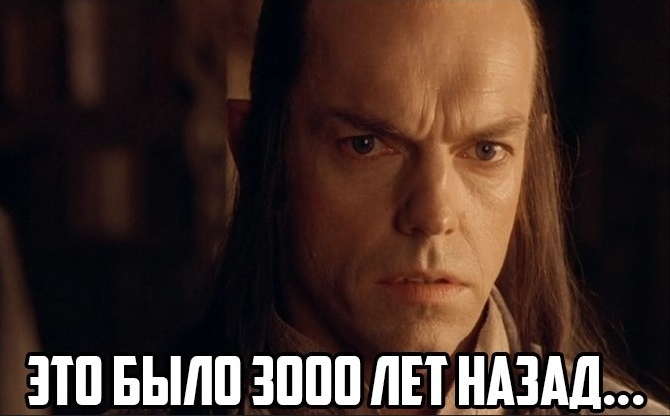
In *The Fellowship of the Ring*, Elrond is present at the Council in Rivendell and tells Gandalf about Isildur's long-ago failure. After Sauron's defeat, Isildur took the Ring but did not cast it into the fires of Mount Doom; the Elven lord witnessed that episode with his own eyes. In Peter Jackson's film this role was played by Hugo Weaving. His calm, heavy recollection concerns the history of Middle-earth, and the words about three thousand years make the elf's long life audible even to viewers who do not know the details.
It is precisely the length of memory that became a convenient basis for online hyperbole. Elrond did indeed live through an ancient event, but the author of the meme caption transfers that scale to things much closer to everyday life: the era of floppy disks, an old forum, a game that has long stopped being updated. The exaggeration works because ordinary human nostalgia gets the voice of a character who really could say: “I saw this.”
When the film became an internet line
The film came out in 2001, while the earliest dated traces of the meme format date from 2018. Among them is an image from April of that year; in the Russian-language segment, a post with the same picture and a joke about the age of an internet meme appeared in the summer. These are the earliest recorded examples, and the exact author of the original meme version has not been established.
The meme carries over not the whole plot of *The Lord of the Rings*, but one convenient construction: Elrond was there when something legendary happened. It is easy to recombine, because it does not require context about the Ring. It is enough to name an object of nostalgia, and a character with an ancient past lends it deliberately epic age. It is especially funny when the object appeared only a few years ago or when the author has only just learned about it.
A face from the memory of the Second Age
The meme frame shows Elrond in close-up: long hair, a stern gaze, warm light on his face. The Russian phrase occupies the lower part and states that the event happened three thousand years ago. There is no second character or elaborate scene here: the face is already serious enough to turn the caption into a veteran's account rather than a simple nostalgic complaint. It also matters that “this was” sounds less personal than “I remember”: the short version compresses the character's lived experience into a single date and leaves room for substitution.
The stern expression does not make Elrond angry by default. It simply gives the phrase the weight of a memory; the comic difference is created by the caption, when it concerns a recently released game or a service that has just shut down. When the object is swapped, the intonation may change too: an old player looks nostalgic, while a newcomer to a forum looks like a self-assured witness to events they barely remember.
Invented examples of age
“This was 3000 years ago: when phones still had a separate headphone jack” is an invented caption exaggerating a recent technological change. “When I downloaded updates at night and hoped the internet wouldn't cut out” turns an everyday memory into an ancient legend. And the line “I was there when the game still let you pick a server manually” suits a young project if the author wants to deliberately present a few months as a whole era. All examples are invented; they use Elrond's scale to emphasize that “long ago” depends on habit and personal memory, not necessarily on actual millennia.