What is visible in the frame
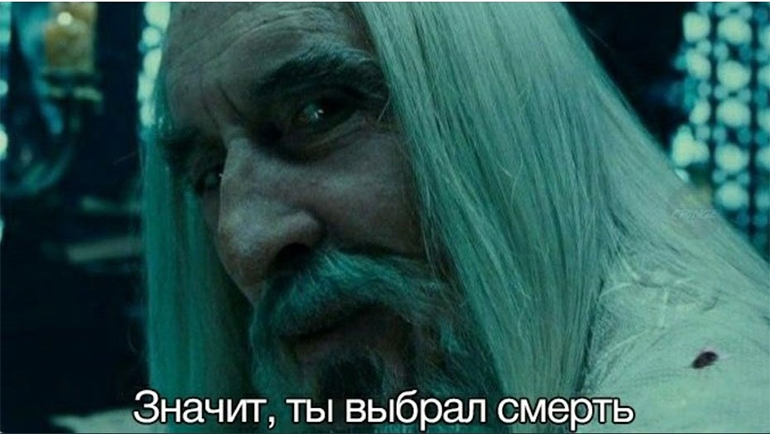
A close-up of an older man with long gray hair and a thick beard. He looks to the side and slightly from under his brows, his face lit by cold blue-green light, eyes narrowed. The background is dark and blurred, with smeared points of light at the edges. Near the edge of the frame, on his white clothing, a dark speck is visible. At the bottom, white lettering reads: “So you have chosen death.”
The picture works without explanation: the face conveys calm resolve, and the caption turns the look into a verdict. The threat here is not shouted but matter-of-fact, and much of the joke rests on that tone.
Where the scene comes from
The frame is from Peter Jackson’s trilogy The Lord of the Rings, specifically the first part, The Fellowship of the Ring (2001). The character Saruman the White is played by Christopher Lee. In the scene at the tower of Orthanc, Saruman tries to win Gandalf over to his side, and after Gandalf refuses, he says that Gandalf has chosen death. Gandalf is then locked at the top of the tower.
The exact wording of the line is best checked against the film itself, since it sounds slightly different across translations and dubs. For a template, what matters is not the precision of the translation but the construction “you made a choice, so the consequences are inevitable.”
How the phrase lives in captions
At first the picture was used almost literally, for serious situations where someone faces a price for a decision. Later a reverse technique took hold: the verdict is pronounced over a trifle. When the solemn phrase collides with a tiny occasion, the result is a comic gap.
The exact date of the first publication of this frame with a Russian caption has not been established, so it is more honest to say only that the template has been familiar to Russian-speaking users for a long time and still appears in discussions and messages. The film’s release date (2001) has no bearing on the meme’s emergence: the frame became a template later.
Another feature: in the scene the tone is calm, without shouting. So the caption can be read silently in an even voice, and the more mundane the occasion, the funnier the drama looks.
Caption examples and how they work
The phrase relies on a mismatch: a solemn verdict is delivered over a trivial occasion. Here are four standalone examples.
“You decided not to take an umbrella even though the forecast promised rain. So you have chosen a soggy hairdo.” The occasion is small, and the tone is solemn. The joke is that a decision not worth a second thought is presented as fate.
“You said you would figure out the flat-pack furniture instructions yourself. So you have chosen three hours with a screwdriver.” The shift here is from an everyday situation to the formula of a verdict. The focused face in the frame carries the thought further.
“You decided to go to the shop without a list. So you have chosen a second trip for the same bread.” The caption rests on a familiar situation: everyone knows that without a list you usually come back twice.
“You promised to wash the dishes after the guests left. So you have chosen a morning surrounded by plates.” The consequences of the choice are known in advance, and the dramatic tone makes them funny.
How to use the frame
The frame suits ironic comments when someone makes a questionable but not dangerous choice. It is best to keep the caption short, because the scene already carries the drama. The formula “You did X. So you have chosen Y” almost always works if Y is noticeably more modest than the tone.
If the joke is aimed at a specific person, rewrite it so that it concerns the situation rather than appearance or private life. For serious topics, where health or safety is really at stake, the template does not fit: the contrast disappears, and only a grim threat remains.