What is depicted
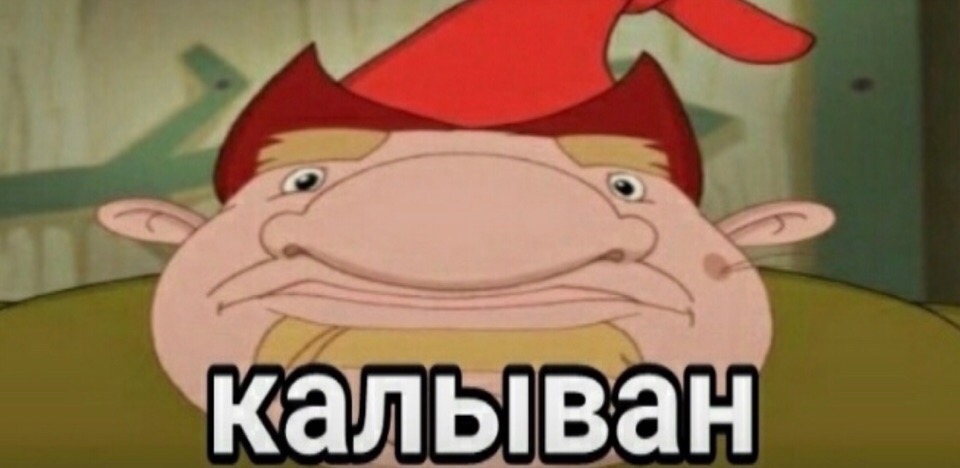
This is a frame from a cartoon, not a specially drawn picture. The face is shot close-up and slightly from below: a round pink face, a huge wide nose, small eyes with visible whites, light yellow eyebrows and mustache, and red hair. On the head is a red cap with a curled tip, and a beauty mark is visible on one cheek. The background is blurred: a wooden wall and green spots.
At the bottom, in white letters with a black outline, it says “kalyvan” in lowercase. There are no other captions, so the meaning rests on the character's face and on one word. The mouth is closed, the lips stretched into a half-smile, and the expression reads sometimes as smug, sometimes as sly.
Why the face is funny
The main effect is that the face fills almost the whole frame and looks straight at the viewer. The nose and cheeks form an almost geometric mask, over which a self-satisfied smirk is frozen. A one-word caption explains nothing, and the viewer fills in the context themselves: who this is, what he is pleased about, and why he looks like that at all.
This format is familiar from many memes built on frames from children's cartoons: a short caption sits beside the image and clarifies nothing. The meaning comes out differently each time, which makes the template convenient to reuse.
It is also notable that the caption is typed without a capital letter and without punctuation. This emphasizes a careless, almost everyday tone: the word looks like a remark tossed off in passing, rather than a title or a name.
Name and origin
The character in the meme caption is called “kalyvan.” Which exact cartoon and episode the frame comes from is not established; online it is most often attributed to Russian animation about epic heroes. Claims about the character's profession, about deliberately distorting his name, and about the date the meme appeared are not reliably confirmed, so they should be treated as guesses.
What is visible in the frame can be described precisely: the word in the caption is written in lowercase with no explanation. This device is often found in abstract memes, where the meaning rests on a recognizable image and a casually written word.
Caption examples
Below are several invented captions. Each sets up a small situation, and the character's face provides the reaction.
“Kalyvan when the cashier miscounted the change, and he said nothing and took it as is.” The smug expression turns a small win into a silent victory: the hero looks as if everything went according to his plan.
“Kalyvan after the second tea, which got cold before the first one.” An everyday pause: a satisfied face does not go well with cold tea, and the gap between expectation and result makes the joke.
“Kalyvan when someone in the chat wrote “who's on the call?” and nobody answered.” A short everyday scene in which the half-smile reads as “I knew it.”
How to use this template
The frame suits reactions to small everyday situations: change at the counter, queues, slow internet, an unexpected bit of being right. Keep the caption short, one word or one phrase, because long text drowns out the facial expression.
If you use the image, keep the colors and proportions of the frame: the red cap and the round face are the main identifying features. For the caption, light letters with a dark outline, as in the original, work best; otherwise text on a light background will be hard to read.