An ad phrase that became a ready-made excuse
In 2012, TNT promoted screenings of the Harry Potter films with the formula “Voldemort Is to Blame.” The advertising idea was built on the familiar image of a villain to whom anything bad can be attributed: he is responsible for the troubles of the magical world, and in the short promo his name was transferred to the viewer’s everyday annoyances. The promo gave viewers a ready-made line for everyday conversation: the same excuse could be repeated even after the commercial had ended. In user-made images, the advertising answer was later combined with new circumstances and different pictures of the villain.
This matters for the meaning of the meme: the phrase did not arise as a random comment under a single snapshot, and it is not a line from J.K. Rowling’s books. Its convenience came from the advertising, which was designed for instant recognition of the character. The name Voldemort already meant threat and malicious intent, so assigning him blame for a broken cup or bad weather makes the accusation deliberately out of proportion.
Rainbow stripes and an exaggeratedly guilty face
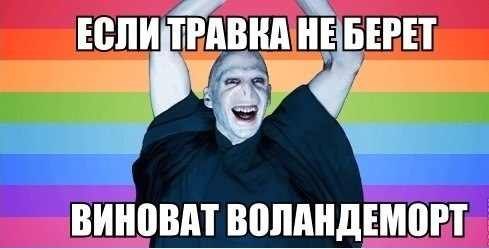
On the picture, over stripes of red, orange, yellow, green and blue, is the caption: “If the weed won’t kick in — Voldemort is to blame.” In the center is a figure with raised hands and an open mouth; the top line names a specific situation, and the bottom line pins the blame on the book villain. This is no longer a TV promo but a user variant of the phrase, in which the first line adds a separate joke.
The word “weed” here refers to cannabis; the text gives no practical information about the substance. The comic move lies in the fact that the supposed cause of the failure is immediately replaced by a fantastical culprit. The background and the wide-open mouth make the image deliberately loud, as if Voldemort has not merely been accused but has been caught triumphantly in yet another prank.
A wizard as the universal culprit
The formula easily outlives the original advertising campaign, because it already contains a ready-made mechanism: name a misfortune, then assign it a ridiculously distant cause. For a viewer of the saga, Voldemort is a character to whom treachery is easily attributed; for someone who does not follow the Harry Potter story, the name still sounds like that of a fairy-tale villain. Too serious a responsibility placed on a fictional wizard amplifies the comedy.
At the same time, the new caption changes the tone of the old one. The TV campaign made a recognizable reference to the film screenings, while user variants can turn any everyday hitch into a scene of accusation. A printer that jams? Of course, the villain did it. A lost sock? It can be chalked up to Voldemort too. Such examples are invented for illustration; they are not documented historical publications.
Invented variations of the phrase
Invented example: “If the alarm clock breaks again by morning — Voldemort is to blame.” A familiar minor misfortune is combined with a grand villain, turning a complaint about a gadget into an indictment. In another variant, friends cannot pick a film: “If we are rewatching the same comedy for the third time — Voldemort is to blame.” Here the character is guilty not of a misfortune but of a funny habit.
The same structure can be moved into an office setting: “If the presentation opened in a mystery font — Voldemort is to blame.” Such a caption can conditionally be placed under any portrait of the villain, but a specific picture adds a more theatrical mood. All these captions are invented and show only the principle of variation: the cause must be minor and understandable, and the culprit must be grand enough that the accusation sounds funny by default.