An event that became a template
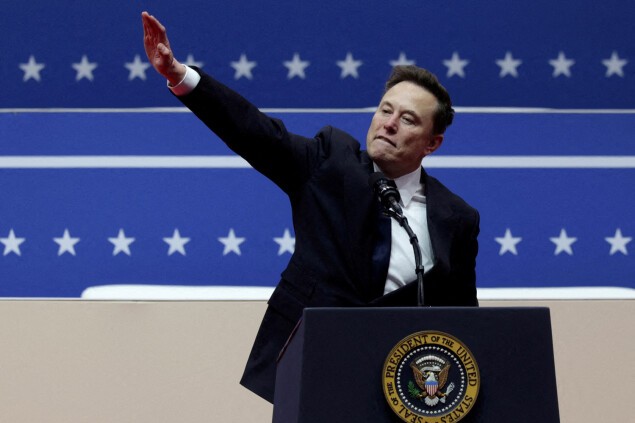
In the image, Elon Musk stands behind a podium against a backdrop of stars-and-stripes panels, his right arm raised diagonally upward. The shot is from a speech at a celebration of Donald Trump's inauguration on January 20, 2025. At that moment Musk put his hand to his chest, then sharply extended it toward the audience and spoke words of thanks. The very next day, news coverage recorded a sharp reaction: many saw a resemblance to a Nazi salute, while Musk himself rejected that interpretation.
An ADL publication separately describes how antisemitic and neo-Nazi users later used this phrase and image in their own material. That's important evidence of the symbol being exploited, but it doesn't establish Musk's intent behind the original gesture, nor does it mean every meme using the shot carries an extremist meaning. The shot's viral spread produced criticism, defenses of Musk, parodies, and political captions all at once.
How the meme compresses the argument
The template became popular because a still image lets you deliver a quick take on a political event without retelling the whole speech. The name "doing a Nazi salute" offers the viewer a specific reading in advance, and an ironic caption can turn the gesture into wordplay about space and Mars. But the picture itself doesn't settle the dispute over context: people see the same hand movement and draw different conclusions about intent. So it's useful to keep the recorded action, the public interpretation, and a proven belief as three separate claims.
How captions unpack "Elon Musk doing a Nazi salute"
A neutral-satirical version: "When the presentation promised delivery to Mars, but all they showed so far was a new gesture." The caption plays on Musk's public image and his space business, without presenting a disputed judgment as fact. Another example, aimed at the social-media reaction itself: "One shot — and the feed is already split between those who see a salute and those demanding full context." Here the target of the joke is the instant polarization, not the person's presumed views.
A third, more neutral option avoids the diagonal pose entirely: "When the work chat asked who'd take the boring task, and a hand shot up a second before common sense kicked in." This caption keeps the joke about a sudden impulse but doesn't repeat the gesture from the shot or recall the inauguration scene. These are new captions illustrating different degrees of distance from the event, not historical captions from the original posts.
Caution when using it
If the goal is to talk about the episode itself, it's reasonable to name the date, the place, and exactly what's visible: the hand moves from the chest upward, followed by words of thanks. The phrase "Nazi salute" can be used to describe the critical interpretation, noting that it was disputed; a contested intent shouldn't be turned into an established biographical fact. A political meme is especially audience-dependent: some readers will recognize criticism, others support or normalization of the gesture.
The shot shouldn't be used to romanticize Nazism, attack groups of people, or hide antisemitic messages behind an innocent caption. If you want to joke about your own enthusiasm, it's safer to pick an unrelated gesture or an obviously fictional character. In this subject, context, source, and the exact target of the joke matter: the meme can spread not only satire about a public figure but also coded hate messages.