An answer to a question about competition
On December 14, 2017, at his annual press conference, Ksenia Sobchak asked Vladimir Putin why the authorities, in her words, are afraid of the opposition. In his answer Putin said that the authorities are not afraid of anyone, then talked about competition and compared the scenario undesirable for Russia with what had happened in Ukraine. The formula “Do you want it to be like in Ukraine?” compresses several fragments of the answer into a question convenient to repeat; in the transcript the president does not say it verbatim.
First there existed a specific question and a long answer at a public event, then a brief formula that could be separated from the conversation. The date of the press conference is confirmed by an OTR recording and a contemporary Interfax report; who first condensed the answer into this phrase, and when it became popular, is unknown. In the meme caption the expression preserves the memory of a political dispute, even when the occasion is everyday.
The gesture in the frame and the added context
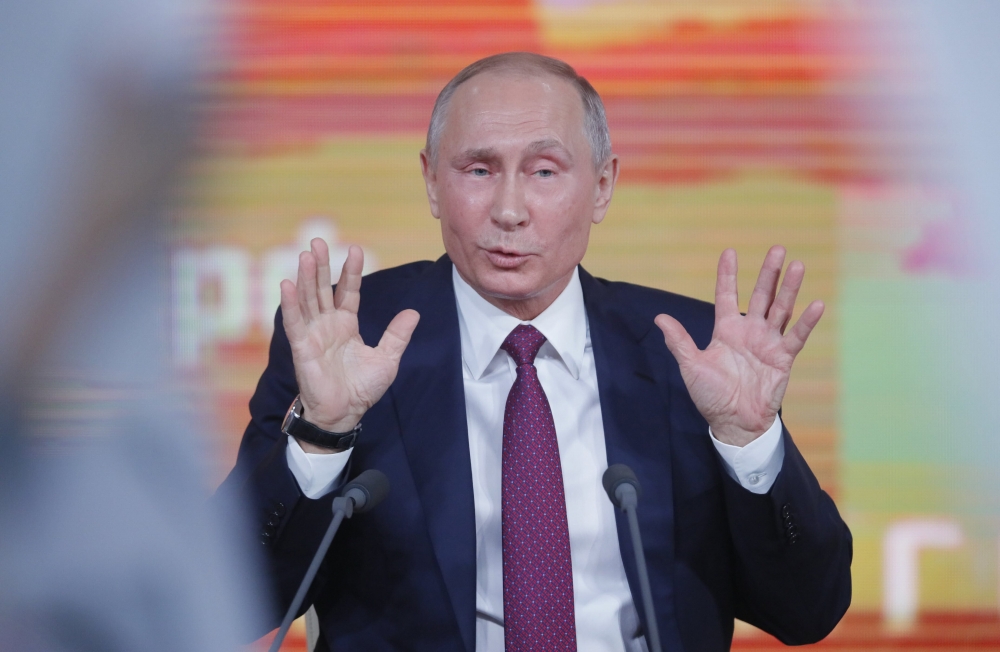
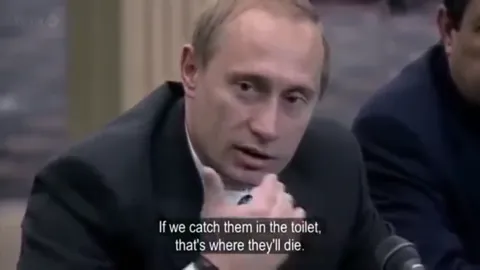
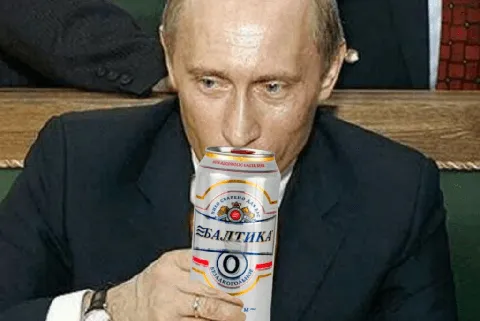
In the photo, Putin sits behind microphones in a dark suit with both open palms raised. This is the only action reliably visible; there is no text in the frame. So the meme formula is attached to the photograph from outside and turns the speaker's gesture into an illustration of an already known dispute, even though the picture itself contains no question about Ukraine.
Open palms can be read as a gesture of explanation, but the picture does not let them be tied to a specific line. It is a single frozen moment of a long speech; the recognizable meaning appears when a question circulating separately is added to it.
How the question became a universal reference
The short form changed the structure of the line: instead of a long answer about political competition, a question remained that itself offers the listener a ready-made analogy. It can sound like a warning in a political argument or like a deliberately inflated reply to an everyday idea. In the latter case the comedy comes from the gap between a small occasion and a heavy historical comparison.
In the original conversation the topic was the Russian opposition and competition in elections; later the question began to be quoted as a short reply to proposals for change. In a political argument it brings the discussion back to the Maidan and an undesirable scenario, while in a casual joke it turns a simple initiative into a supposedly fateful one. Between these uses the scale changes, but the form of a rhetorical question that presupposes in advance the danger of change is preserved.
Invented captions
Invented caption: “In the entryway someone suggested putting up a bulletin board. Do you want it to be like in Ukraine?” An overly alarming reply does not match the scale of the proposal, and it is exactly this mismatch that creates the comic effect.
Invented caption: “The team is discussing changing the button color — Do you want it to be like in Ukraine?” Here the short line cuts off a minor dispute instead of explaining a preference. In both examples the political formula remains recognizable but is not attributed as a real quote from the photograph.