What is written and drawn
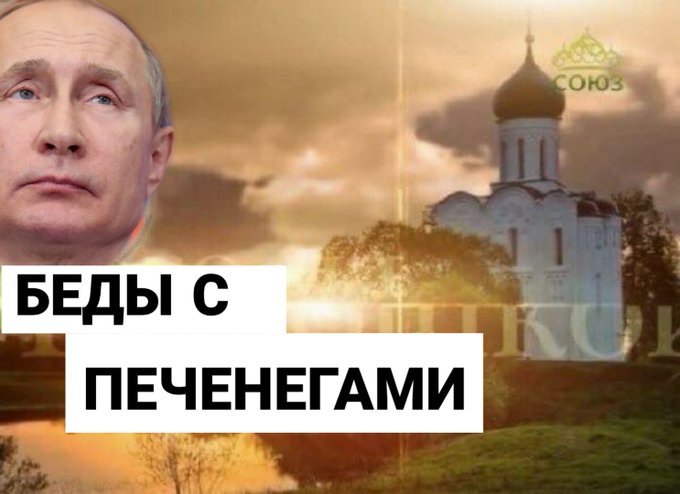
In the upper left corner, a close-up of Vladimir Putin's face with a serious gaze. The background is styled like a TV intro: a white-stone temple with a dark dome on a meadow, water, and a sunset sky; in the upper right corner is the 'Soyuz' logo. At the bottom, on white banners, in black letters: 'TROUBLES WITH THE PECHENEGS'.
The design resembles a religious-patriotic program or intro: a lofty picture and a solemn headline. The joke is built on this contrast, since the headline refers to nomadic peoples who disappeared many centuries ago.
What Putin said
On April 8, 2020, at a meeting with governors and ministers on measures against the spread of the coronavirus, Putin said: 'Our country has gone through serious trials more than once: the Pechenegs tormented it, the Polovtsians too, and Russia coped with everything.' News headlines presented this as a promise to defeat 'this infection'.
Interestingly, he had used the same image before: Meduza recalled that the president had talked about the Pechenegs and Polovtsians some ten years earlier, when the country was coping with forest fires. So some users took the phrase as a familiar move rather than a fresh metaphor.
For the reader of this catalog, it is important to remember that the meme mocks a style of argumentation, not the people who were ill at the time. It uses a recognizable quote and adds no new facts to it, so it should be read as political and everyday irony, not as a document.
Who the Pechenegs and Polovtsians were
The Pechenegs are first mentioned in Russian chronicles under the year 915, and in 1036 Prince Yaroslav the Wise defeated them near Kyiv. The Polovtsians appeared on the borders of Rus' from the 1050s and troubled Russian lands until the Mongol invasion of the 13th century. These were real nomadic peoples, but they have nothing to do with the present day.
The combination 'Pechenegs and Polovtsians' has long been a playful image of distant antiquity in Russian speech, so many people perceived a serious comparison with an epidemic ironically.
Why the phrase caught on
The epidemic demanded decisions in hospitals, schools and enterprises, while the speech focused on the scale of history. For many listeners the gap between the expectation of specifics and a historical story looked comical, and the phrase quickly turned into a meme.
The joke, however, is not about the nomads themselves but about the style of explanation: when a question about the present is answered with a reference to the past.
Caption examples
'I asked when the elevator would be fixed. They answered: we've been through worse, troubles with the Pechenegs.' The caption moves the situation into everyday life.
'When the boss was asked about a bonus and recalled the 1998 crisis.' A modern take on the joke about a pointless analogy.
'Parents, when asked for pocket money: back in our day...' An example of a family version.
'The internet went down, but we lived without it before. Troubles with the Pechenegs.'
How to use the template
The meme fits comments on situations where, instead of an answer, people get a general cheerful speech. It is not necessary to tie it to politics: it is enough to copy the composition and swap the face or the caption.
If you want to play on the history itself, make sure you do not attribute to the picture's figures phrases they never said: the authentic quote concerned the Pechenegs and Polovtsians, while the other 'continuations' were invented by users.