What is in the image
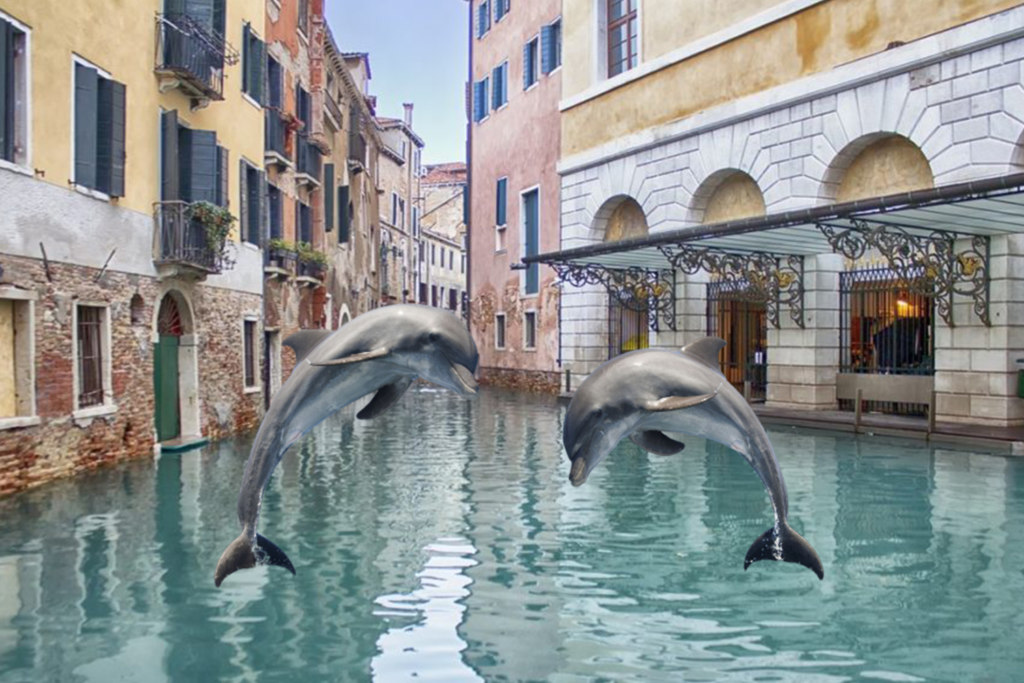
A narrow canal between old houses with peeling plaster: on the left, facades in ochre and brick shades, green shutters, small balconies with plants; on the right, a light stone building with arches and a wrought-iron canopy. The water is turquoise and calm. In the center of the frame are two gray dolphins leaping out of the water in arcs.
On closer inspection, the dolphins cast no shadows on the water and their lighting does not match the scene: they are cut-out shapes laid over a photo of the canal. The author of the collage is unknown.
How the fake spread
In March 2020 Italy went into strict quarantine, and messages spread online that swans and dolphins had returned to Venice's canals. Checks by journalists and fact-checking services, including Snopes and Euronews, showed that the dolphin video had been filmed off the coast of Sardinia, where such pods occur even without a quarantine. Swans do indeed appear in the canals of Burano, an island that belongs to the Venetian Lagoon.
The only true part was that the water in the canals looked clearer: with the canals empty, less silt was stirred up from the bottom, not because the water had become cleaner in composition. But the pretty picture proved stronger than the explanations.
Why the fake proved so durable
In spring 2020 people wanted to believe that the pandemic had at least some bright side. The idea that 'nature is recovering without us' needs no words, and the dolphin picture looks like a postcard. That is why the collage spread even in places where sources are usually checked.
Later the phrase 'dolphins returned to Venice' became an ironic reference to a pleasant piece of news that is too good to be true.
How people joke about it
The joke works as a response to a cheerful rumor: the caption admits that you want to believe it, but warns that it should be checked. It is often attached to any 'miracles' from the feed: tigers walking around the city, a sudden discount on everything.
The meme can be gentle and kind, because its target is not people but the habit of believing pictures without a source.
It is also notable that the story gave people a rare shared experience: many encountered checking a news item in practice for the first time. The habit of looking for the original image and checking the date and place of filming spread more widely then, and the dolphin joke is often recalled as a prompt for such checking.
A sign of a successful caption: the reader smiles and at the same time understands that it is about a dubious news item, not about real animals. If the caption makes people seriously argue about Venice, the joke has not worked.
Caption examples
'I was told that tomorrow the office meetings will be canceled. Dolphins returned to Venice.' The feeling: too good to be true.
'News: rent prices will drop. Source: a friend of my brother's classmate.' The caption shows what rumors rest on.
'Me, when I found a report submitted on time.' An everyday version of a miracle.
'Fact-checking, round one: the dolphins turned out to be in Sardinia.'
Tips
The picture works well when you want to gently question something without making accusations. In the caption, do not call real people liars: the point of the joke lies in the mechanism of rumors itself.
You can also refer to the real part of the story: the swans on Burano were real, and there is a simple explanation for the look of the water.