What is drawn
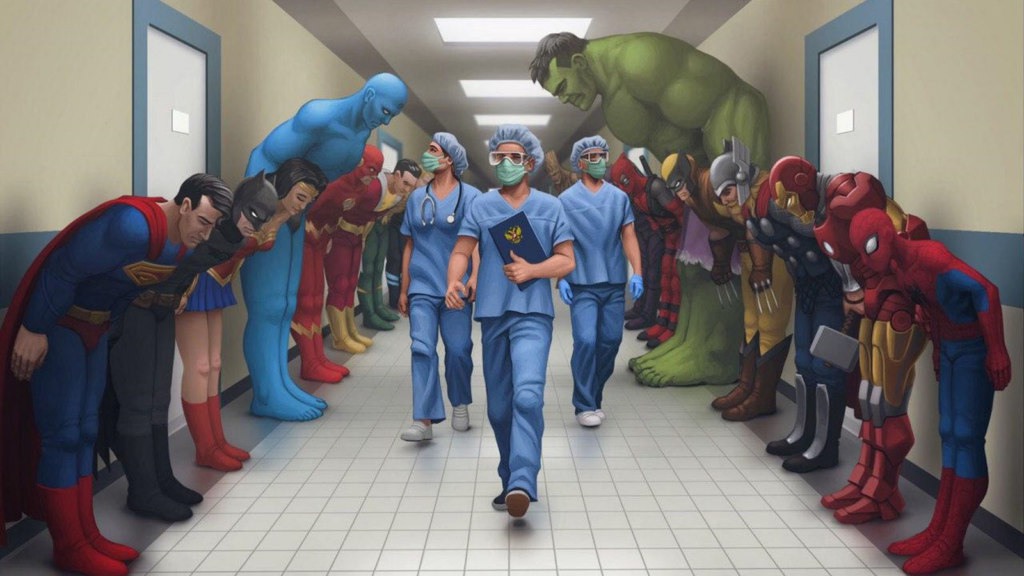
The corridor is bright, with ceiling lamps and a tiled floor, and closed doors along the sides. In the center, three people in blue surgical clothing, caps and masks walk; the middle one wears protective goggles and holds a blue folder with a coat of arms. They do not look around and walk in a businesslike way, as on an ordinary shift.
Bowing heroes line the walls. On the left are Superman in a red cape, a dark Batman, a heroine in a blue skirt, a red Flash and a blue glowing character; on the right are the enormous Hulk, Deadpool, Wolverine, Thor, Iron Man and Spider-Man. All are bent in a bow, and the largest, like the Hulk, are bent down almost to the ceiling.
The colors are arranged so that only the heroes' costumes look equally bright, while the doctors' uniforms are a calm blue: the difference in saturation emphasizes that glory and daily work look different.
Where the idea comes from
The picture spread in 2020, when the coronavirus pandemic was sweeping the world and expressions of gratitude to medics were growing on social media. Professional works with a similar idea appeared at the same time: for example, on May 6, 2020, a work by Banksy was published in which a boy plays with a nurse toy in a Superman pose, while Spider-Man and Batman lie in a trash bin.
Who exactly drew this corridor of bows cannot be reliably established, so it is better not to name the author. The main thing known is that the drawing became a symbol of recognizing people of a real profession alongside fictional strongmen.
How the idea reads
The meme works on a reversal of roles. Usually in such corridors people bow to strength and capes; here strength bows, while ordinary people walk. The superheroes along the walls are like an honor guard, while the group of medics calmly walks past.
Because of the size and variety of the heroes, the viewer sees not one but a whole row of universes gathered for one purpose: they agree that true courage lies elsewhere.
The composition works too: the central line of the corridor leads the eye straight to the walking medics, and the bows on the left and right are symmetrical. The viewer first sees the heroes, and then understands that the most important people in the frame are those walking between them.
Examples of captions
The captions are invented for illustration. For teachers: “All the heroes bow to the one who survived the parents' meeting.” The structure of the joke stays the same: the hero in the middle is a person with simple but heavy work.
Everyday variant: “All the heroes bow to the person who assembled the wardrobe without any leftover parts.”
Work variant: “All the heroes bow to the colleague who answers emails five minutes before vacation.”
Home variant: “All the heroes bow to the one who got up to the alarm on the first try.”
How to use it
The template sounds best with genuine gratitude or with good-natured humor about small wins. Caption the central figure and leave the heroes' bows as they are.
If the joke is about doctors' work, avoid mockery: the picture's original meaning is respectful, and irony about medics would ruin the idea.
The template's good tone comes from specificity: the more precisely the feat in the center is named (“brought someone else's project to release”), the deeper the bow. General words like “best person” blur the joke.