What is visible in the picture
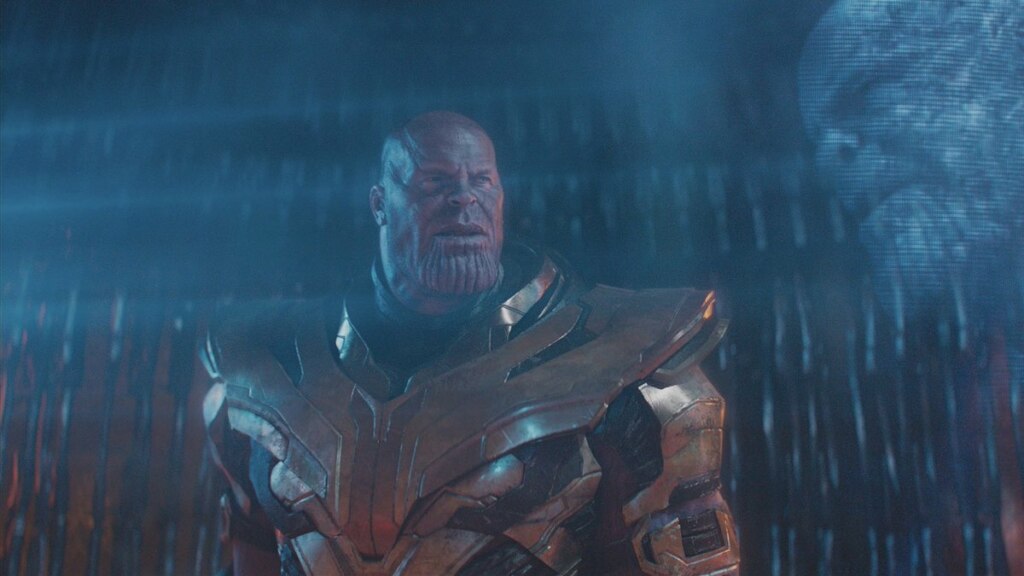
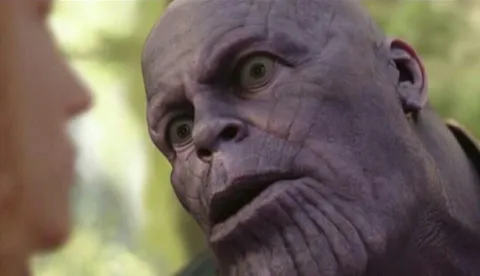
Thanos is shown from the waist up, in golden-bronze armor with embossed plates on the shoulders. The lighting is cold, blue-cyan, and vertical pale streaks that look like rain or interference run across the frame. His head is bald, he has a beard on his chin, and his gaze is fixed forward and slightly upward.
In the upper right corner, a large rounded object with a textured surface is faintly visible. It is out of focus, but it creates a sense of vast space behind the hero.
Where the line comes from
Thanos is the main villain of “Avengers: Infinity War” and “Avengers: Endgame.” In the first, he wipes out half of life in the universe, and in the second the remaining heroes try to undo the consequences of his decision with time travel.
According to descriptions, the word “Impossible” is attributed to a line from “Endgame.” Which exact moment of the film this frame relates to cannot be reliably determined, so it is better not to tie it to a specific scene. The time the template appeared and the first posts based on it are also not established.
Why one word works
“Impossible” is a short and categorical reaction. It expresses not just surprise but a refusal to accept a fact. When the word is paired with a serious face in heavy armor, the result is a comic mismatch: before us is a fearsome character who is not ready to come to terms with a minor surprise.
That is why the template fits situations where a person runs into a detail they did not account for. The viewer recognizes the intonation without any explanation: they, too, once refused to believe the obvious.
Caption examples
A few invented variants.
“Made a plan for the month, and it turned out there's a Tuesday in it. Impossible.” One unexpected fact breaks the whole calculation, and the hero's serious face underlines the scale of the catastrophe.
“They said delivery is free, but only for orders over a thousand rubles. Impossible.” Here the reaction looks too serious for a small detail, and that very disproportion creates the joke.
“Put the kettle on, turned around, and it had already boiled. Impossible.” The caption flips expectation: an everyday event is presented as a violation of the laws of nature.
In all the examples, the fact comes first, and then the short reaction.
What makes the frame expressive
The cold blue-cyan lighting and the vertical pale streaks that look like rain or interference create a sense of bad weather, and against this backdrop the golden-bronze armor with embossed plates looks especially heavy. The face, meanwhile, is almost calm: the hero does not shout or gesture, he looks forward and slightly upward, as if trying to grasp what he has just heard. This calm makes the reaction funnier, because the word “impossible” is usually accompanied by shouting and sharp gestures, while here there is silence and a heavy stare instead. The caption picks up exactly this restrained intonation and turns it into a response to any unpleasant news.
How to apply the template
To make the caption sound convincing, it is better to put the word at the end of the phrase and not add explanations. A pause before it makes the reaction more expressive than a long text.
The template should not be used to mock other people's misfortunes or real individuals. Its strength is that it laughs at the situation and at the very attempt to deny the obvious, not at a specific person.