Titan before and after the catastrophe
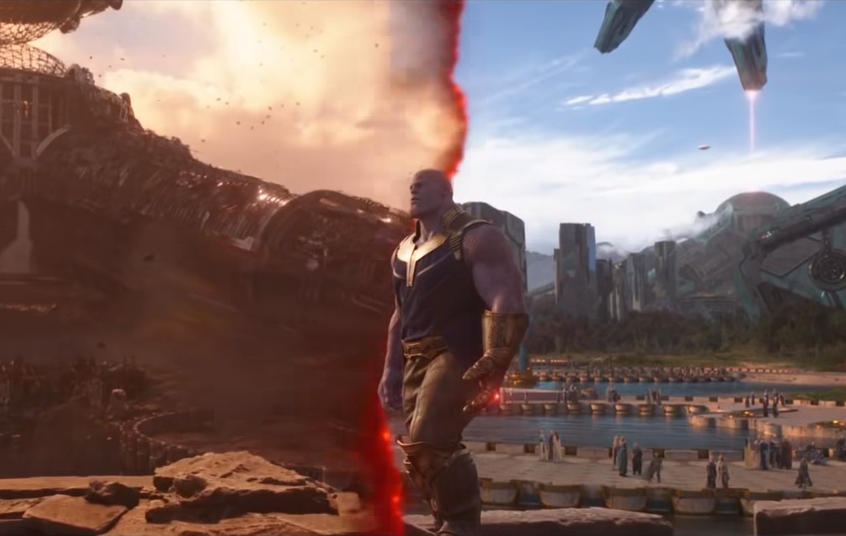
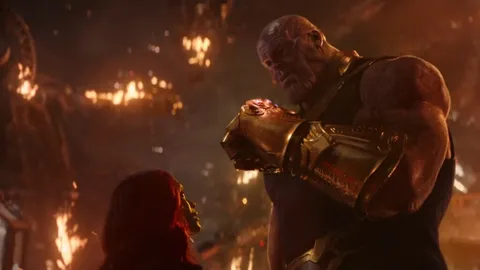
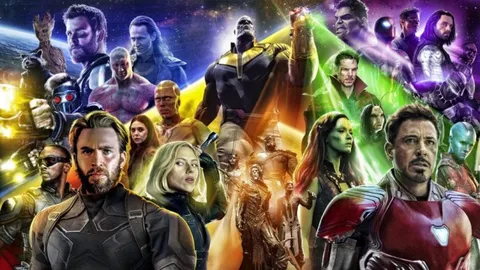
The format is tied to Avengers: Infinity War (2018). In the film Thanos explains why he considers his actions necessary, and talks about Titan, his home planet. His words “It was a home. And a beautiful home” refer to the place he remembers before its destruction. In the frame used for the meme, this memory collides with the planet's present appearance: one half is dull, damaged and almost lifeless, the other flooded with sky and water reflections.
This montage does not simply divide the image into “bad” and “good.” Thanos is not talking about a vacation that was accidentally ruined: he ties the beauty of home to an irretrievable former life. That is why the phrase keeps a note of great loss even when it is attached to a silly trifle. The picture recalls a familiar place, and the caption turns an everyday change into a small legend about a lost paradise.
How the red dividing line became a memory
Thanos stands by a vertical red boundary. Behind him, on the left, are dark wreckage and smoky light; on the right, blue sky, water, buildings and ships above the city. The composition makes time visible: past and present are placed side by side, and the hero seems to stand on the border between them. The color also works as a short story: warm ochre suggests dust and destruction, cool blue suggests calm and open space.
Importantly, the picture itself carries no caption. The format's name suggests the line, but the joke can exist without literal quoting: it is enough to juxtapose two versions of one place. Someone who sees old swings and new paving on a playground may recall the old yard; a viewer will compare this private experience with their own. At the same time the image does not prove that the former version was objectively better: it shows the view of someone for whom it became home.
Nostalgia without a time machine
In online variants, Thanos's words are moved to a school canteen, a long-closed shop, an old app interface or a route that has since changed. The turn is funny when the serious scale of the film collides with ordinary memory: the hero speaks a line about the fate of the world, while the viewer remembers the bun they bought after class. Sometimes the contrast between “then” and “now” really signals loss; sometimes it is just exaggerated sentimentality.
The template also carries a gentle irony about memory itself. A person may remember the old yard as flawless, though it had puddles, a broken bench and dull evenings. The beautiful right-hand fragment is not necessarily a documentary snapshot of the past: in the meme it often becomes a screen onto which an idealized version is projected. So the substitution works both as longing and as a joke about the habit of decorating what is gone.
Invented captions
An invented example: on the left, today's yard with a gray guard booth; on the right, an old photo of it with swings and trees familiar from childhood. Caption: “Our yard before the renovation. It was a home, and a beautiful home.” Here the change is not catastrophic; the dramatic voice turns childhood memory into an epic. The order of the two photos keeps the contrast of the original frame: the present view next to a colorful memory.
Another invented example could be about a music player: on the left, today's recommendation of fifty similar tracks; on the right, a playlist listened to on road trips ten years ago. Thanos's line fits not because the service has become worse for everyone, but because a specific user misses their former ritual. A third variant: a favorite café that rearranged its tables — the hero stands between the old interior and the new one and mourns the spot by the window. In every case the personal loss stays small, and the comedy comes from a comparison that is disproportionately solemn.