A frame from the cave
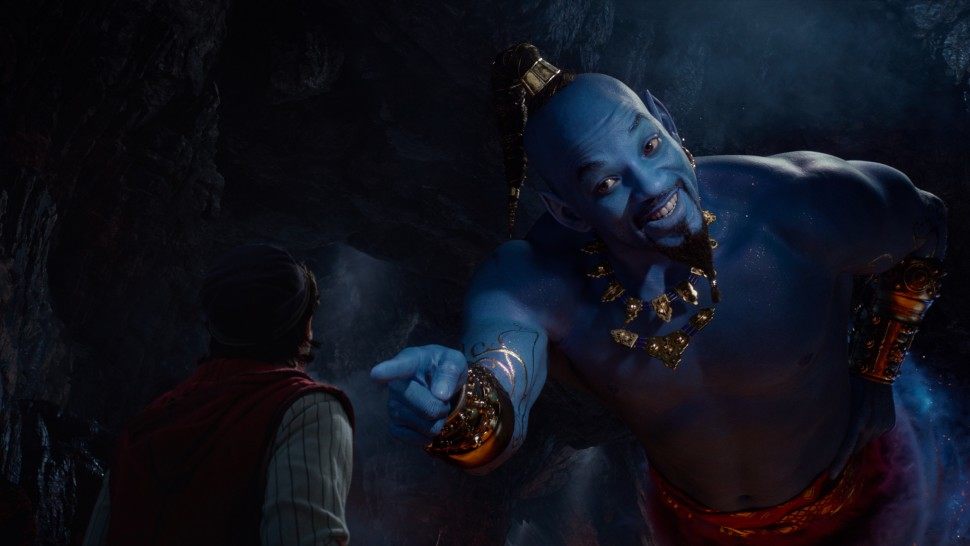
The picture is a close-up of a character with blue skin, a long braid of hair at the crown, a pointed beard and a wide smirk. A massive gold necklace hangs at his neck, and gold bracelets are on his wrists. He leans forward and extends an arm, pointing left, toward a man in a red vest over a striped shirt, who stands with his back to the viewer.
The background is a dark stone cave with haze. The light is cold, so the blue skin looks especially striking. That color is what drew the attention.
The Grammy Awards trailer
Disney showed a new trailer for the live-action “Aladdin” on February 10, 2019, at the Grammy Awards ceremony. It was the first look at the blue genie played by Will Smith, and the reaction was mostly negative: social media users discussed the computer graphics and the character's appearance.
In response, memes and photoshopped images appeared. Among the comparisons, according to reports, was one to Tobias Fünke from the series “Arrested Development,” who dyes himself blue to get into the Blue Man Group. The film opened in US theaters on May 24, 2019.
The 1992 cartoon and expectations
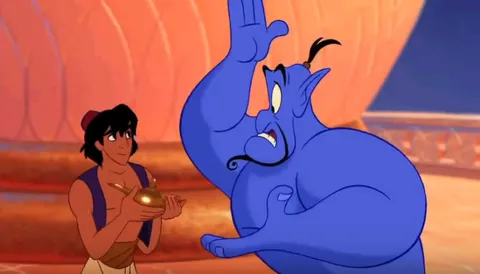
The genie in the 1992 animated film was also blue, but in a drawn picture the color read as part of the style. When the same color was transferred to a live actor, the result was a combination of a realistic face and bright “cartoonish” skin, and that combination became the source of the jokes.
What is funny here is not the appearance of a real person but the clash of expectations. Viewers remember a cartoon where the genie was blue and cheerful, and the new version promised something more lifelike. The gap between these two images became the basis of many jokes.
Why the picture is easy to remake
The meme works at the level of form too: the character smiles and points a finger at his interlocutor. The finger gives the caption a point to lean on. The same picture can easily become an accusation, an invitation, or a jab at oneself.
The blue color also works as bait for wordplay: in Russian, “синий” (blue) has several meanings, and captions often use exactly those.
Captions with a blue tint
The examples are made up for this frame.
“I waited two hours for tech support, and now I'm blue myself, like after a system error.” The line relies on wordplay: “blue screen” in talk about computers means a crash, and a long wait is presented as its direct result. The viewer picks up both meanings at once.
“I turned blue from the cold while waiting for the bus.” The expression “turning blue” is taken literally, and the blue color becomes a state of the body. The everyday detail makes the joke recognizable.
“You, who promised not to buy another cable. Yes, I'm pointing at you right now.” The genie's finger is aimed at the interlocutor, and the caption uses exactly this gesture.
How to use the template
The template works best in stories where someone unexpectedly ends up in an unfamiliar look or someone is being called to account. It matters that the joke concerns the situation and not the appearance of a real person. One short phrase and a frame with a gesture are usually more expressive than a long text.
The frame is best cropped to the face and hand. That way the pointing gesture stays the main thing, and the cave background does not distract from the caption.