The scene in the film
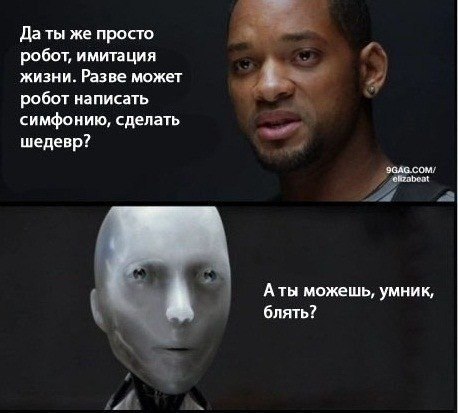
In Alex Proyas's I, Robot, police detective Del Spooner, played by Will Smith, treats robots with distrust. He says a robot is nothing but an imitation of life, and asks whether a machine can write a symphony or create a masterpiece. The scene is built around an argument about what separates a human from a machine.
Spooner's interlocutor is the robot Sonny, a computer-generated character voiced by actor Alan Tudyk. The dialogue ends with a question Sonny asks in return, and it's precisely that reply that became the main basis for the memes.
How the line became a meme
On the Russian internet the line was turned into a caption for a still: Will Smith delivers the words about the robot, and below it is the reply, translated and rewritten in a somewhat crude register. There's a version with the robot's face from the film and the text arranged in two blocks. A watermark from a popular image-sharing site on the picture suggests the template spread through social networks.
The exact date the Russian translated version appeared has not been established: a search wasn't available this time. The meme's entry lists the year 2014, which is likely the year it spread widely, whereas the film itself came out in 2004.
The template is easy to repurpose for any topic involving a dispute about the capabilities of machines versus humans. All it takes is swapping the caption, and the still works as an illustration for a new situation while keeping the original contrast between arrogance and a sharp retort.
The point of the joke
The whole construction rests on a reversal. The first speaker confidently belittles the machine, assuming creativity is beyond a robot's reach. The second line throws the reproach right back with a counter-question. The argument thus turns into an everyday squabble where each side is certain the other is incapable of anything.
This structure suits memes well: a short phrase, a clear contrast, and a recognizable face. That's why the template is often used to respond to criticism in comments or in arguments about someone's abilities.
Ways it's used
In chats, people use the phrase to tease someone who speaks too confidently about other people's abilities. Irony matters here: the sender understands that they themselves don't always look any better.
Sometimes the meme is applied to technology. When people discuss neural networks, text generation, or music generation, the film still becomes a handy illustration for the debate over machine creativity. Such discussions often circle back to the very question the film posed.
Cultural context
I, Robot is one of the notable early-2000s films about the relationship between humans and machines. Its theme remains relevant, which is why lines from it regularly resurface in memes, especially whenever artificial intelligence comes up.
The joke also rests on the actor's recognizability: Will Smith's face reads instantly, and the contrast with the robot's cold expression adds comedy without needing any further explanation.
What's more, the scene itself keeps coming back into discussions about machine creativity. Whenever new programs appear that can write poetry or paint pictures, viewers recall Spooner's question and Sonny's reply, and the meme becomes a quick way to sum up that long-running debate in a single image and a single line.