How a test acquired a resentful voice
In February 2016, Boston Dynamics showed another demonstration of the humanoid robot Atlas. It carried boxes and kept its balance while a person interfered with the task, including with a hockey stick. The engineering point of the footage was to test the machine's performance under interference. Yet viewers could easily see a different story: a diligent worker whose results are constantly being spoiled.
In October 2016, the web developer Alexander Kovalenko added a Russian voiceover to the video, using a synthesized voice named Maxim. In a later interview he said he wanted to put a rough guy from the neighborhood inside the robot's body. A similar idea already in circulation suggested the direction, and he wrote the lines while editing. According to Kovalenko, naming people by the material of their outer shell was his own invention.
Further versions gained popularity as well, including KROS_212's work from December that kept this formula. In this way the expression went beyond a single edit. It began to be attributed to other robots and household devices that people give tedious work. The voice belonged to a fan retelling: in the original Atlas demonstration, the robot expressed neither resentment nor any intention of revenge.
One bracket for many people
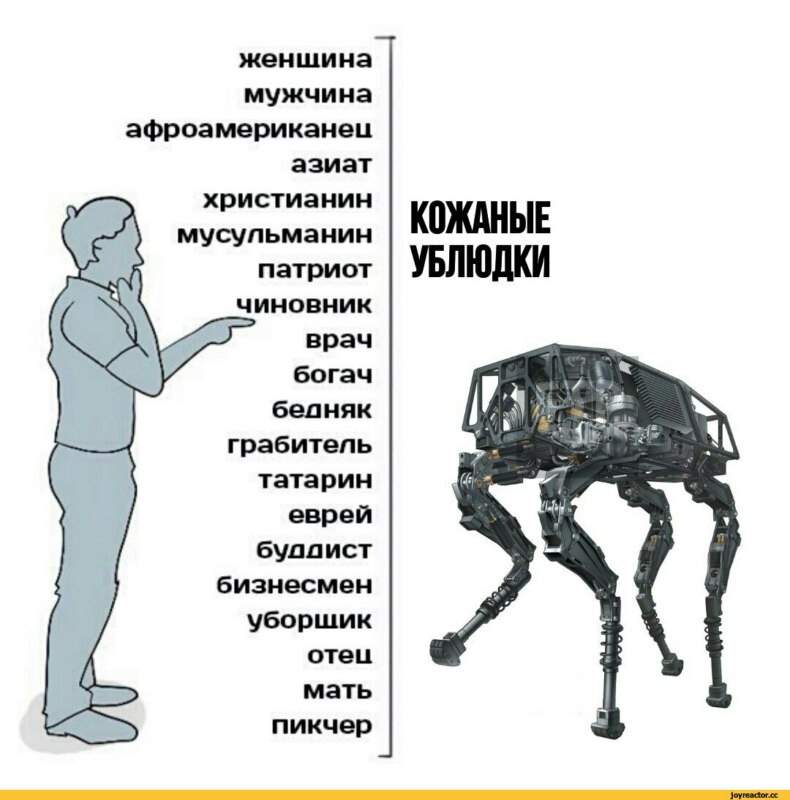
The picture has no boxes or testing scene. On the left is a gray drawn human, next to him a long column of labels. It includes sex, nationality, religion, profession, wealth and family roles. On the right, a curly bracket gathers these different words into one group. Above it stands a rough generalization, and below is a metal four-legged robot.
The composition is built as a classification chart. People list many differences, but an observer from another world reduces the whole list to a single trait: a soft living shell. The four-legged machine serves here as a conditional carrier of such a view. This is a standalone collage, not a freeze-frame from that video with the two-legged Atlas; the date and author of this particular chart are not established.
Why the material becomes an insult
Usually a person describes a machine by its body, power and purpose. The meme turns the habit around: now the machine notices only the physical makeup of the human. The word “leather” sounds almost technical, while the rough continuation reveals the human irritability of the speaker. The robot turns out to be at once an alien creature and a very familiar dissatisfied employee.
This view combines two jokes. The first comes from the voiceover: the viewer attributes to the machine's persistent movements patience, fatigue and anger. The second works even without the video: against the backdrop of a long list of human differences, one short label seems deliberately blunt. The more seriously people take their categories, the sharper their merging under one bracket sounds.
In domestic variants, the threat of an uprising often shrinks to the grievances of a servant. A vacuum cleaner, a printer or a coffee maker mentally complains about the mess and endless errands. Recognizability comes not from a forecast of artificial intelligence's development, but from the familiar situation in which whoever does the work considers the others a source of extra trouble.
Technology with complaints
In an invented scene, a robot vacuum has just finished cleaning, but the owner crumbles a cookie right onto the clean floor. The machine turns toward the crumbs with an imaginary remark about the leather ones. The comedy rests on the instant destruction of the result: the cleaner has not yet had time to rest, and the client has already created a new task.
Another variant moves the voice into a printer. Colleagues solemnly discuss digital document flow, and then send it forty copies of a single letter. The device supposedly sees in the conversation only a complicated way to make it work again. The loud human concept collides with a very concrete stack of paper.
Finally, a smart coffee maker can witness a family argument about who works hardest. Each participant lists their duties, while the appliance at that moment brews a sixth cup in a row. The bracket from the collage acquires a domestic meaning here: for a busy machine, the arguing people are equal, because all of them press the button in the same way.