What the photo shows
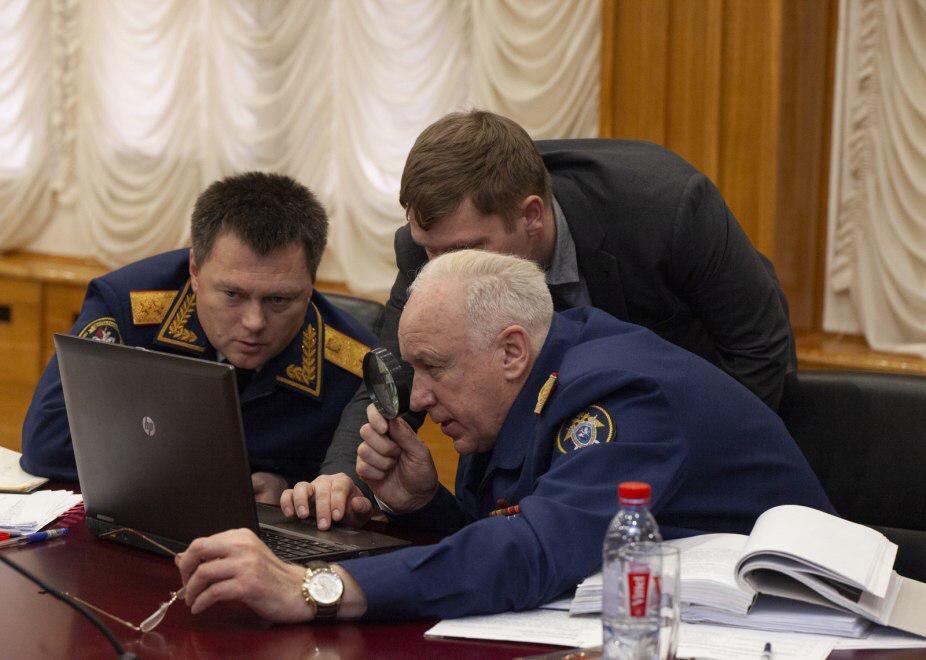
The photo shows three people at a table with a laptop. On the left is a man in a dark blue uniform with gold embroidered shoulder boards; behind him, leaning toward the screen, stands a man in a dark suit. In the foreground, a gray-haired man in a blue uniform with an emblem on his chest holds a magnifying glass to his eye and peers at the screen. On the table there are a bottle of water, an open folder with papers, and glasses.
The hero of the frame is the chairman of the Investigative Committee, a public figure, and the photo was taken at an official event. That is why jokes usually rely on the plot, that is, the magnifying glass and the screen, rather than on the person's appearance or identity.
March 2019 and the first posts
According to media reports, the photographs were taken on March 13, 2019, during a personal reception of citizens in Moscow. Russian outlets noticed them on March 18: in one of the frames the agency head looks through a magnifying glass at a laptop screen while an appeal is being discussed. The images quickly spread across social networks, and the first captions appeared.
The meme arose as a reaction to a real photo, not to an edit. Who came up with the first caption is unknown.
The press service's explanation and the dispute around it
In response to a news agency's request, the Investigative Committee's press service said that the quality of the video recording discussed at the reception does not allow confident conclusions about shadows and traces on it. It also noted that optical magnification with a magnifying glass differs from digital zoom, and that the chairman goes into details at receptions.
The outlet Meduza objected: a magnifying glass cannot add details that are not in the screen's pixels, it only enlarges what exists. Journalists suggested a simpler explanation: the man uses reading glasses for documents, and small text on a screen is easier to make out with a magnifying glass. This is a supposition, not a confirmed fact; no official explanation of that kind exists.
Why the captions work
It is not the magnifying glass itself that is funny, but its mismatch with the era. A tool familiar from paper and photographs turns out to be in front of a laptop, and the contrast is clear without any explanation. Next to him in the frame stand two colleagues who are also looking at the screen, which turns the photo into a small scene with its own storyline.
The second part of the joke is anticipation. The viewer sees a person staring intently and mentally fills in what exactly he has found. That is why captions usually take the form of a guess about what is on the screen, rather than an assessment of the person.
Caption examples and their logic
“Searching the laptop for where the ‘Send’ button is” — the caption explains the gesture as a search for an ordinary function. The contrast between a powerful instrument and a simple task makes the joke understood at once.
“Trying to read the fine print in the user agreement” — the magnifying glass becomes an excuse for any long reading. The joke rests on a recognizable situation that everyone knows.
“Looking at a kitten photo on the internet” — a shift from an official scene to an everyday one. A change of expectation, not an insult, creates the laughter.
“Checking whether the Wi-Fi works in the office” — a practical task for which a magnifying glass is not needed at all, so the caption looks absurd.
How to use the frame
The frame suits situations where you need to examine something, find a small detail, or make sense of complicated instructions. It is better to avoid political hints and judgments: the plot works as an everyday joke about attention to detail.
If you crop the photo, keep the magnifying glass, the screen, and the bowed heads: this composition alone explains the joke without any text.