A political question that became a reaction
Reference sources trace the phrase's appearance to forum and political discussions from 2022; it became more noticeable in the fall of 2023, when the formula began to be used regularly in arguments about events and audience reactions. A link to the forum 2ch comes up in retellings, but isn't backed by a primary post that would let you establish the original author. It's therefore safer to speak of early use in political communities and its later spread, without passing off a reconstruction as an established authorial debut.
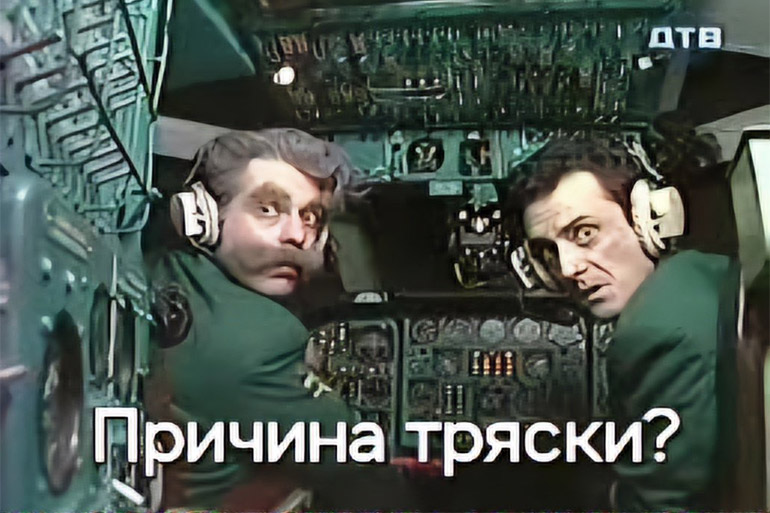
The image contains two men's faces placed into a dark cabin, with the caption 'Why the shaking?' The faces are fitted together too tightly for an ordinary shot — this is clearly an edit, and without a confirmed original, no names can be attached to them. The text itself matters more here than the photographic source: the question is used as a mocking comment on someone else's disagreement.
A rhetorical device and its cost
The question doesn't call for an actual answer. It preemptively declares the opponent emotionally upset and shifts the conversation from the subject of the argument to the other person's presumed state. It's a device for dismissal: the author is effectively saying the critic is 'shaking,' so their arguments don't need to be addressed. Later versions can use the phrase more loosely, for instance when something is simply very annoying, but the original polemical edge remains noticeable. On political forums it often accompanied a response to news the author saw as inconvenient for an opponent.
Because of that edge, the meme can feel like a winning comeback even when it hasn't refuted a single argument. In a friendly chat it can be applied to your own reaction to a broken alarm clock; in an actual conflict it's more likely to pour fuel on the fire.
The formula also has a tactical effect: it forces the other person to defend their tone rather than their position. Repeated without an ironic framing, it quickly turns into a personal jab and shuts the discussion down.
Examples with a clear target
A self-deprecating version: 'I've been arguing with an app that won't accept my password for ten minutes. Why the shaking?' The question is aimed at the author themselves, so it doesn't paint an opponent as unreasonable. Another example, among friends: 'Hey, who removed the shared playlist from favorites? Why the shaking?' Here the dramatic formula exaggerates a tiny digital inconvenience.
If the image is used as a comment on some loud online argument, a caption like 'The feed's been arguing for three days about the color of a button — why the shaking?' mocks the sheer scale of the reaction. These are independently made-up applications, not primary political quotes.
Don't mistake sarcasm for an answer
The template fits post-ironic exchanges where both sides understand they're discussing a meme device. In a genuine argument, it's better to lay out your disagreement rather than replace it with a question about the other person's supposed agitation. If the image is used as self-deprecation, add a specific, mundane reason so the reader doesn't take it as an attack. A locally edited image with disputed faces can be swapped for a neutral illustration if specific people aren't essential to the joke.
The phrase carries a political trace and sometimes serves as a tool for mockery. Don't use it to bully people, and don't treat an expression captured in an edited image as proof of anyone's emotion. The question can be funny as an exaggeration of your own irritation, but it doesn't establish that an opponent actually feels what's being attributed to them.