From a playful creature to famous faces
The creation of the early version is linked to Paperboard The-Great, author of the “Cardboard Public.” According to his account, in winter 2017 the question was placed over a photo of a clay creature depicting the Carnivorous Cube from Hearthstone. That original post has not survived, so the author's account should be distinguished from the available dated publications. Early traces of its spread appear in the Forsen community in early 2018.
In summer 2018 the phrase went beyond a narrow group. Among the July variants a photo of Vladimir Putin appears; afterward the question began to be attributed to other recognizable characters and individual words were changed. The visual base proved replaceable, but the short, check-like intonation remained. The format's history belongs to absurd captions, not to a phrase documented as actually spoken by a politician.
A serious conversation gets derailed
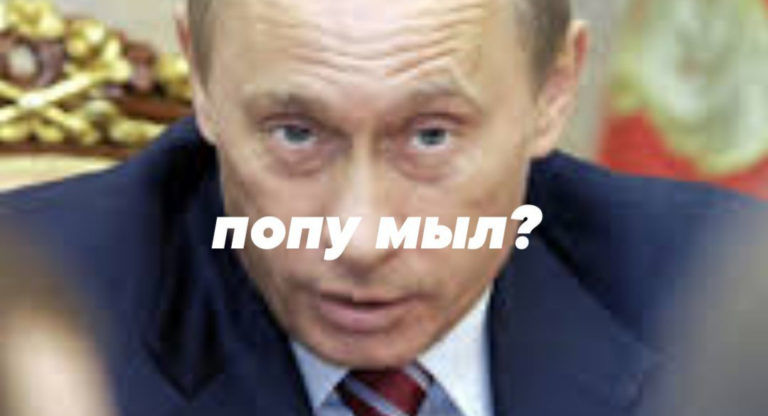
In the picture Putin leans forward toward the person in front of him. A suit, a red tie and decorative elements of an official setting are visible; another participant's face is blurred in the lower left corner. White text is placed across the central part of the portrait. The question takes up only two words, so the reader notices it almost at the same moment as the stern gaze.
The photo promises negotiations or discussion of a significant topic. The added text sharply reduces this scale to a crude everyday question, behind which one can hear an unpleasant warning. The visual authority receives a line that does not match the official setting. There is no answer from the interlocutor in the picture, so the pause becomes part of the provocation. The author of the photo and the circumstances of its original publication are not established for this image macro.
A polite question with a crude undertone
The formula is linked to an old joke about the “room of fear”: an ordinary question about cleanliness turns out to be a hint of a sexual threat which the listener has to finish constructing on their own. Therefore, reducing the original meme to an innocent reminder about morning hygiene would be wrong. The unspoken element works here as provocation: the words contain no direct announcement, and the intonation and serious face invite suspicion of a much more unpleasant continuation. This is the construction of a crude joke, not evidence of the intentions of the person in the photo.
In absurd remakes the line could appear without a coherent story and lose part of its original hint. Nevertheless, its recognizability rests on ambiguity: a simple question sounds like a check before something unexpected. The decorative font of early variants additionally set the soft design against the provocative content. In the image with Putin, the white insert does not imitate an official document. Changing the figure changes the force of the contrast, but does not turn the edit into a genuine recording of a conversation.
Invented checks before a hard task
First invented plot: “A friend promised to hold a debriefing after my bad move in a board game.” The stern face depicts a disproportionate threat, while the everyday scale of the game shows that this is a conditional role. Second variant: “After the line ‘let's calmly discuss the mistakes,’ the host of the gaming chat sends this picture.” The expected conversation gets a provocative pause that participants read as a crude joke.
Third example: “Said the level would be easy, and got to a huge final boss.” The picture gives an imaginary opponent a voice that promises an unpleasant test in advance. These captions are made up for adult gaming conversations and do not describe real threats or actions by a politician. The short question remains the final punchline: if the whole supposed continuation were spelled out in detail, the unspoken element on which the original provocative effect rests would disappear.