What is visible on the poster
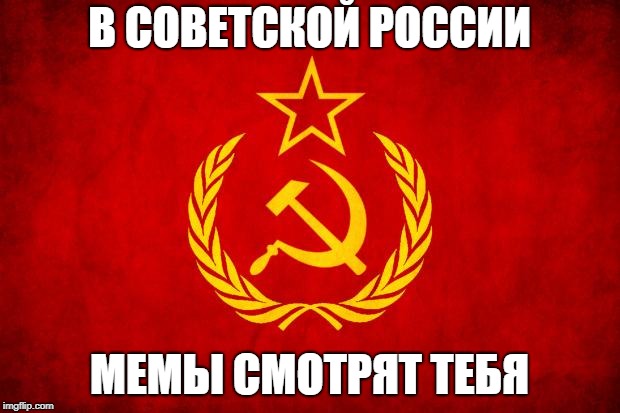
The background is a saturated red with a grainy texture. In the upper part, in light capital letters, it reads “IN SOVIET RUSSIA,” and at the bottom, in the same letters, “MEMES WATCH YOU.” In the center is a gold five-pointed star above an emblem: a hammer and sickle inside a laurel wreath, both symbols rendered in gold.
In the lower left corner there is a small watermark of the service where the template was created. It has nothing to do with the joke, but it shows that the image was taken from a ready-made generator and the caption was added on top.
Where the formula came from
The “In Soviet Russia” formula is usually associated with the comedian Yakov Smirnoff, who performed in the United States. However, he himself, as is noted, rarely used this construction. Time magazine traces the earliest example to Cole Porter's 1938 musical “Leave It to Me!,” while Bob Hope brought the device to a wide audience at the 1958 Academy Awards ceremony.
Online, the formula spread through compilations and videos in which all kinds of situations were flipped. It was used as a reply to any statement about an action: “I walked the dog” — “In Soviet Russia, the dog walks you.”
It follows that the formula should not be credited to a single author: it has long lived apart from any performer and is perceived as a shared genre.
How the reversal works
The joke rests on mirroring. The subject and the action swap places: where in the ordinary world a person looks at something, here something looks at the person. This device is called antimetabole: repetition of words in reverse order. The reader recognizes a familiar structure and immediately sees the swap.
The picture adds a second layer. The poster is styled like propaganda, with a solemn emblem and sloganeering intonation, while the object of ridicule is memes, the least serious things imaginable. The gap between the solemn presentation and the trivial subject is what creates the comic effect.
It is important that the joke is not about the country as such. The formula uses an image and a style, not history. It is about the viewer's expectations of a poster and of a familiar phrase, so no conclusions about real people should be drawn from such a caption.
Examples of captions
Below are examples written for this article. They are all built on one pattern: a familiar turn of phrase, a swapped subject, and an unexpected object.
“In Soviet Russia, the playlist chooses you, not the other way around.” The reversal is applied to a service, and an everyday thing becomes a power. It is funny because of the mismatch between a playlist and a propaganda poster.
“In Soviet Russia, the alarm clock gets up first.” The short caption relies on a recognizable morning detail: the swap makes the alarm clock the master of the day and the person the one who gets woken.
“In Soviet Russia, the chat reads you before you open it.” Here the reversal amplifies the common feeling that messages arrive faster than you want them to. The sloganeering frame underlines the tone of helplessness, and that is what makes the phrase funny.
What to keep in mind when choosing a caption
The template is strongest when the caption is short: it holds the rhythm of the poster. A long text breaks the feeling of a slogan and turns the joke into a retelling.
Do not transfer the formula to real people or to a specific country as an object of mockery. Let the target be an object, a habit, or an internet phenomenon. Then the joke stays about the situation, not about people or history.
If a caption relies on symbolism, it should be read as a stylization. The poster with the hammer and sickle works here as décor, not as an argument, and this approach helps avoid mistaking the joke for an assessment of real events.