What is in the picture
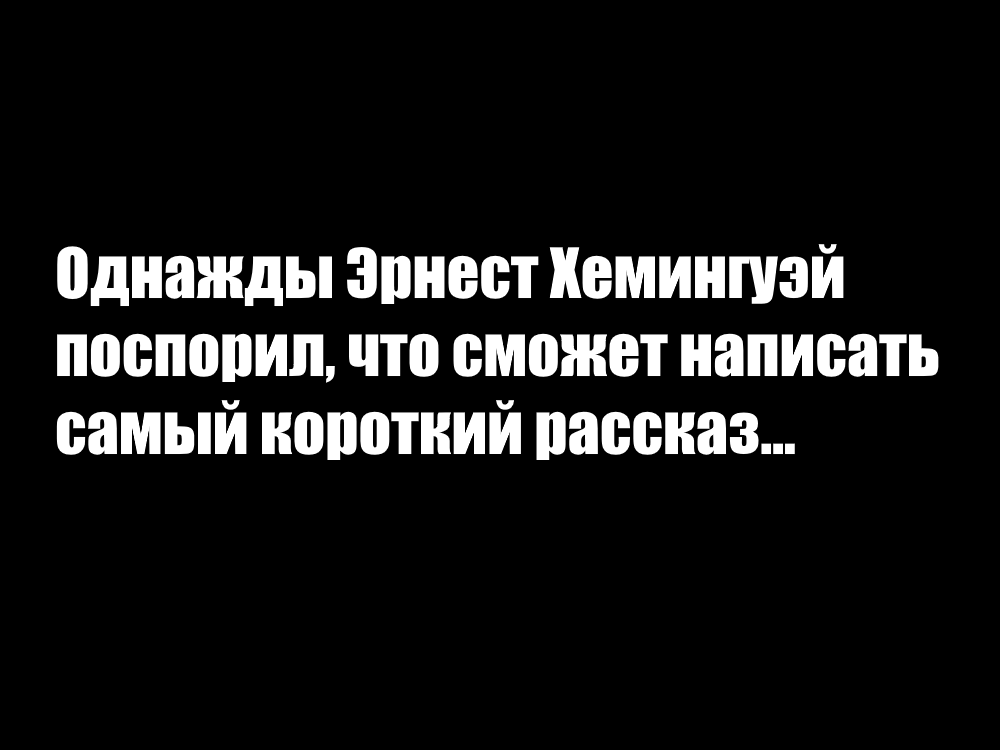
The frame is almost empty: a black background and three lines of narrow, heavy white letters. There are no drawings, no photographs, and no author’s signature. The text breaks off with an ellipsis, as if the narrator pauses before the main point. The announcement itself is not given in the picture: it is left for the reader who knows the legend.
This format is ideal as a template: the opening can be kept while the ending is replaced with your own. The dark background reads well on a small screen, and the dense typeface gives the statement solemnity, as if something important is about to be said.
The legend of the bet
The classic retelling goes like this: Hemingway bet fellow writers that he could write a story in six words, collected the money under the terms of the wager, and won. In one version the stake is ten dollars. Where the bet supposedly took place varies from one retelling to another, and there is no documentary confirmation of the scene.
The text itself, “For sale: baby shoes, never worn,” has become a model of laconic prose: it contains no names and no reasons, but it does contain an event that makes you want to explain it.
What is said about authorship
Literary historians treat the legend with skepticism. The earliest known link of this phrase to Hemingway is attributed to John De Groot’s one-act play “Papa,” first staged in 1989, almost thirty years after the writer’s death. The story was then repeated in books and memoirs in the early 1990s.
Similar notices were printed in American newspapers long before that. An 1883 newspaper carries an ad for a baby carriage that no one has used, a very similar note appeared in 1906, and in 1921 a magazine quoted a comparable ad from a Texas newspaper. All of this shows that the formula existed in print before any legend, and Hemingway was attached to it later.
Why emptiness works
The six words contain no child, no parents, and no reason. There is an object, its condition, and the fact of a sale. From the gap between what is said and what is implied, the reader assembles a plot on their own: why the shoes are new, why they are being sold, what happened in the family. The emotion is created by the reader’s own imagination, which is why it is stronger than any detailed story.
An explanation would only get in the way: it releases the tension and hands the reader a ready answer. That is why every word carries weight, and the word “never” means no less than “baby shoes.”
Examples of captions in the same logic
“Selling Wi-Fi. Password not changed since 2014.” The form of the ad is kept, and the last detail hints at a story that needs no explanation: the reader pictures the apartment and the neighbors themselves.
“Selling running shoes. Worn once: on the way to the finish line my friends were waiting for me.” The expectation shifts: the item looks new, and the reason turns out not to be sad but funny.
“Giving away a sofa to good hands. The hands are already good, the sofa chose them itself.” The furniture becomes a character, and the text stops being an ad.
All the examples rest on one rule: a recognizable form is kept, and one detail changes. The shorter the phrase, the faster the twist arrives.
How to use the template
The picture fits posts about things that look new but have a history of their own: a purchased and unused membership, a gift that was given away, an unfinished book. If you change the ending, stick to six to eight words: then the emptiness stays in place, and the explanation at the end does not destroy it.