A threat preceded by a condition
The English construction It’s Over for You Bitches has been visible on Twitter since at least 2013. Early examples could sincerely promise superiority after one striking change in appearance or behavior. Later, authors began to lengthen the conditions and choose tasks whose completion looked increasingly distant. The overconfident line gradually acquired a stable, self-ironic reading.
Such versions are especially noticeable in 2017 and during a new wave in March 2018. The phrase remains confident, but its opening reveals the narrator’s unfinished business. Rivals are formally supposed to be frightened of the coming success; the reader, meanwhile, understands that nothing threatens them yet. The contradiction requires no special character or recognizable frame, so the format freely exists as a short text post.
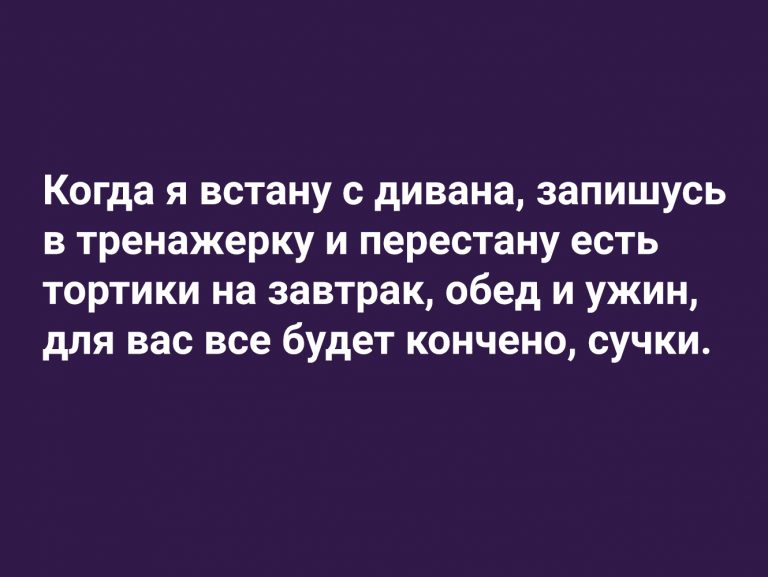
Cakes take all three meals
The image lists three preliminary actions in white letters on a purple background: get up off the couch, sign up for the gym, and stop eating cakes for breakfast, lunch and dinner. Only after them comes the menacing promise to rivals. The author is not shown, nor are the targets of the threat. The whole scene is built from word order and the contrast between a mundane list and an abrupt ending.
The triple mention of food amplifies the exaggeration. The narrator describes the habit as if sweets had completely replaced any other routine. This is neither a credible food diary nor an explanation of a health condition, but a comic version of one’s own inertia. The future gym sounds impressive, yet the very first obstacle remains the simplest movement: getting up off the couch. Victory is postponed even before real preparation begins.
Self-confidence protects against one’s own story
The format’s strength lies in simultaneous boasting and admission of weakness. The final part lets the author play an invincible hero for a second. The conditional part reveals why the hero so far exists only in imagination. The more thoroughly the obstacles are listed, the more the final confidence looks like a funny compensation for the lack of action.
The address to rivals here is often directed at nobody in particular. It creates a small scene of competition even if no one is competing with the narrator. The hostile address sounds like a deliberately excessive theatrical line. In the self-ironic version, the main target of mockery remains the author: they have already declared everyone else defeated, although they still have to complete the entire list of tasks they just drew up themselves.
Three victories postponed
For example, a beginner guitarist might write: “When I learn to move my fingers, tune my guitar and stop losing my pick, it’s over for you.” The dream of a big stage sits alongside the difficulties of the very first lesson. The threat to fellow musicians is funny because its author must first achieve a fairly modest result.
In another imagined version, a person promises to beat everyone at chess once they stop mixing up the pieces, remember the castling rules, and can calmly lose to a friend. That last condition changes the scale of the story: the brilliant tournament is still far off, and the immediate task becomes patience over a home board.
The third scene concerns a home library. The narrator will become the most educated member of the company as soon as they stop buying new books instead of reading them, find a bookmark and finish at least the first chapter. In this case the format plays on the gap between the appealing image of a reader and the actual activity of reading. All three examples keep future success possible, but make the conditions for it the main content of the joke.