What is written on the picture
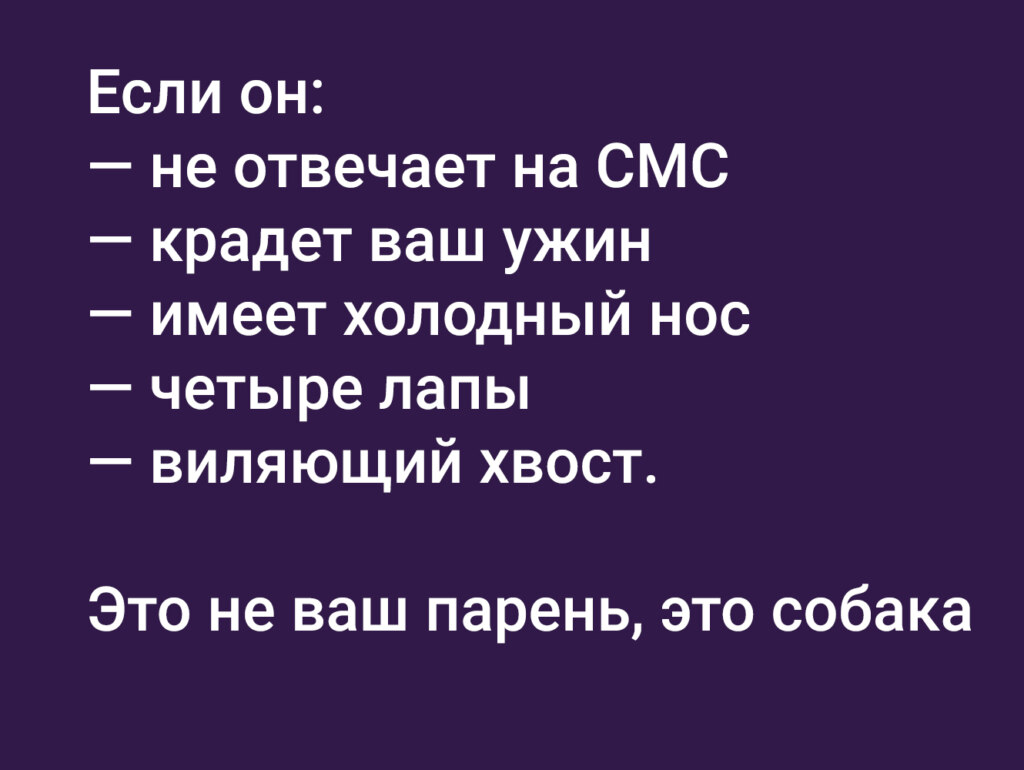
White text is set on a solid dark purple background, with no drawings or decoration. At the top is the line “If he:”; below are five dash-marked points: doesn't reply to texts; steals your dinner; has a cold nose; four paws; a wagging tail. At the bottom, on a separate line, is the twist: “This isn't your boyfriend, it's a dog.”
The first points sound like ordinary complaints about a partner, and only the last line flips the meaning. The minimalist frame reads in a few seconds, so the formula works for pictures without illustrations.
The English prototype
The Russian picture repeats the structure of an English-language format called “He's Not Your Man.” According to reports, it became noticeable in 2018 on Twitter: the list of signs ended with an unexpected figure, for example an American president of the 19th century. The author of the very first version and the exact date are not established; sources disagree.
How exactly the Russian version with a dog came about, whether it is a translation or an independent adaptation, is unknown. What is certain is that the format came to the Russian-language internet together with the general scheme of “a list of everyday signs and a twist.”
Mechanics of the twist
The device is built on substitution. The reader at first thinks they are getting friendly advice about an unreliable person and brings in their own expectations. Each item can be understood in two ways: “doesn't reply to messages” and “steals dinner” fit a partner, while “cold nose,” “four paws” and “wagging tail” gradually narrow the circle and lead toward the real answer.
The joke's quality is that the dog doesn't look like a bad option but rather like a reason to smile: the flaws turn into endearing habits. The contrast between the wary tone of a warning and the tender twist makes the formula warm.
Caption examples
Below are three invented captions in the same vein.
“If he: sends memes at three in the morning, remembers your shoe size, and sleeps across the bed. This isn't your boyfriend, it's a cat.” Each item looks like care or jealousy, and the ending releases the tension.
“If he: waits at the entrance, gets excited at every doorbell, and brings slippers. This isn't your boyfriend, it's a retriever.” The familiar picture of care turns out to be canine attachment.
“If he: disappears all day, comes back with muddy paws, and demands dinner. This isn't your boyfriend, it's a yard cat.” The hint about paws sets up the answer, and the short word becomes the twist.
The scheme is the same everywhere: three or four everyday items, one hint, and a twist in the last line.
How to use the template
For the formula to work, the items must be short and recognizable, and there must be exactly one twist. Long phrases break the rhythm, and overly explicit hints kill the surprise: it's better to leave one ambiguous item closer to the end.
The ending is easier to make about an animal, an object or a phenomenon, so the joke stays playful. Unexpected but recognizable figures work well too, like a household pet, a favorite dish or even an alarm clock: the main thing is that after the last line the reader mentally rereads the list and smiles. Substituting a real person turns the formula into a dig and destroys the gentle tone it exists for.