Picture and text
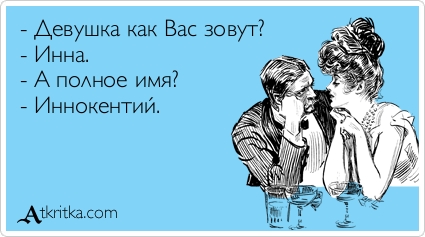
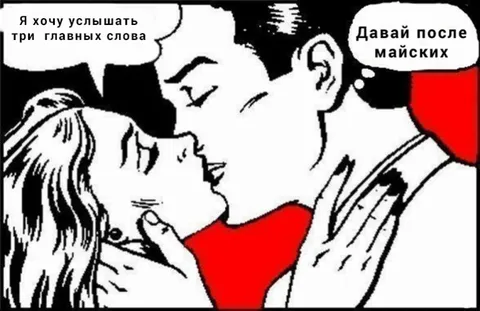
The picture has a light blue background and a black-and-white drawing in the style of the early 20th century: a man in a jacket, head propped on his hand, leans toward a woman with a tall hairstyle and an ornament on her neck. Glasses stand on the table below. In the top left are four lines of dialogue: “Miss, what is your name?”, “Inna.”, “And your full name?”, “Innokenty.”
The picture creates a sense of a society acquaintance, but the joke does not depend on it: it can be read as a caption without the picture, and it is the text that carries the main meaning.
How the anecdote works
The question about a name is a standard everyday situation of getting acquainted. The answer “Inna” sounds familiar and natural, so the listener expects no trick. The second question, “And your full name?”, should give the long form, and it unexpectedly turns out to be the male name “Innokenty”. So a short female name turns out to be the beginning of a male one.
The mechanism resembles other verbal jokes built on sound coincidences: at first the listener takes the answer for an ordinary name, and only afterwards realizes that the phrase overturns the expectation. The logic is that the interlocutor is not obliged to be who she was assumed to be, and the duality of the name works as a trap for attention.
Origin not established
There is no reliable source that indicates the first publication of this dialogue or the author of the text. Such short dialogues in the form of postcards with captions in the style of old illustrations spread across Russian-language sites and social networks, and in such cases the original source is usually lost.
The exact date of appearance and the first author remain unestablished, so any stories about the origin of the joke should be taken as conjecture. For the reader the device itself matters more: it needs no context and is understood by anyone who knows at least a couple of Russian names and their diminutive forms. That is exactly why the joke survives retellings and copying so easily.
Caption examples
Below are examples invented for this template; they show how the joke changes when the name changes.
“— Miss, what is your name? — Klava. — And your full name? — Klavdiy.” The structure is the same, and the meaning rests on the short name sounding like an ordinary female one while the full name unexpectedly turns out male — just as with Inna and Innokenty.
“— Miss, what is your name? — Nika. — And your full name? — Nikifor.” The short name sounds like an ordinary female one, and the full form flips it: the pause before the answer makes the turn more noticeable.
“— Miss, what is your name? — Eva. — And your full name? — Evgraf.” The same device as with Inna works here: the short name hides a male form.
How to use the template
This format suits short dialogues where the shift from the familiar to the unexpected matters. It works well when the second question sounds natural and needs no explanation, and the answer makes the reader go back and reread the first one.
Names in captions are better chosen as fictional and not tied to real people. If you use the name of a specific acquaintance or public figure, the joke quickly turns into a personal story, and its humor depends on a sound coincidence rather than on someone else’s biography.