What it shows
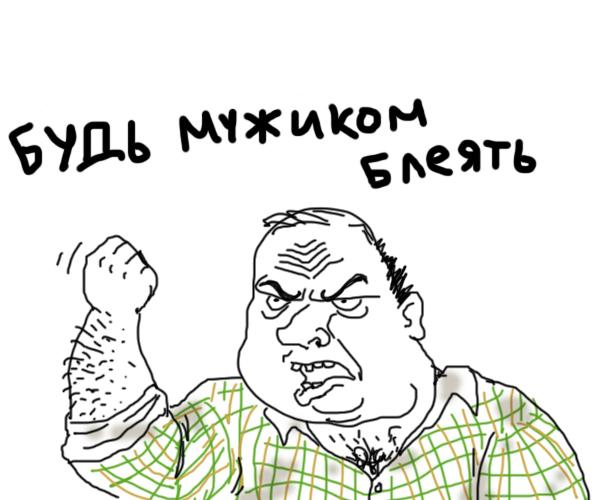
The picture shows a middle-aged man with a crudely drawn face, furrowed brows, and clenched teeth. His raised left arm is clenched into a fist, and his forearm is covered in thick hair. He's wearing a plaid shirt with green and yellow stripes. Above his head, in large black letters, is the phrase "Be a man bleat."
The drawing is done in a deliberately crude style: the lines are uneven, the proportions are cartoonish, and the background is white. This style is typical of early internet comics and makes the character generic: he isn't a specific person but a generalized image of a "real man" who gives orders and takes no objections.
Origin
According to available information, the drawing first appeared on the imageboard Dvach in the spring of 2010. It was posted as a reply to a user's post about relationship troubles — hence the call to "be a man." The identity of the artist has not been established, nor has the original source of the image.
Many variants appeared later: users redrew the character, added gaming references, such as the centaur from the game Hexen, and changed the caption to fit different situations. The template quickly spread beyond the imageboard and traveled through forums, groups, and meme generators.
The meaning of the word "bleat"
The meme's key feature is the word "bleat" [bleat'] in the Russian original. In Russian it has no independent meaning on its own, but it sounds similar to a crude swear word. So the phrase immediately gets a comic skew: a stern demand gets mixed with a pseudo-profane exclamation that sounds aggressive and ridiculous at the same time.
Later a pun emerged as well: the Russian verb "bleat'" also means to bleat, the sound a sheep makes. So the caption came to suit situations where the character looks helpless and his "manly" resolve looks absurd. The phrase "be a man" itself is widespread across the whole post-Soviet space as a way of goading someone, and the meme pushes it to the point of absurdity.
How it's used
The template's typical structure: above the character is a demand, and at the end is a specific task. For example: "Be a man, bleat. Take out the trash," "Be a man, bleat. Stop whining," or "Be a man, bleat. Call your mother." The task can be anything, from mundane to joking, and the whole joke rests on the contrast between the tone and the subject.
The character gets redrawn for each situation: he might show up in an apron, holding a phone, or with a different facial expression. This way the template stays recognizable while also adapting to context, from friendly jabs to ironic comments on everyday hassles.
Why the meme caught on
The meme's strength lies in contrast. A crude, almost aggressive drawing and a dead-serious tone don't match the trivial things the character is demanding. Instead of an epic feat, what comes out is "do X," and this mismatch in scale produces the comedy. On top of that, the template is easy to read: one figure and a short caption, and the meaning is clear without explanation.
Another reason is recognizability. The image is identified instantly in a feed, even if the user doesn't know the source. The meme plays with the idea of the "real man" and mocks the bravado-laden tone that often shows up in internet comments and advice. It keeps appearing in discussions as a quick reference to that style of communication.