What the picture shows
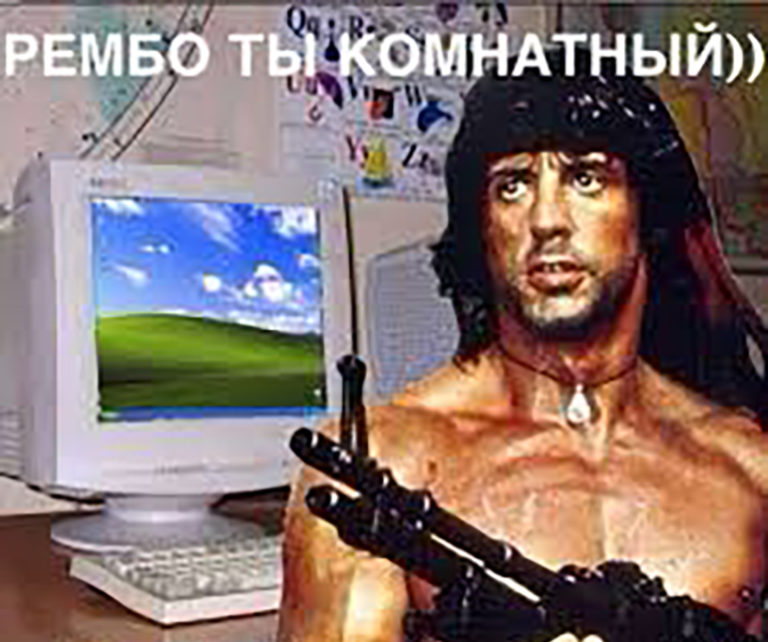
White capital letters across the top read “RAMBO, YOU'RE A HOMEBODY))”. On the left is a beige monitor with a cathode-ray tube, its screen showing a blue sky, clouds and a green hill, like the default Windows XP wallpaper. A keyboard is visible at the bottom, and on the wall behind the monitor hangs a poster of the alphabet.
On the right, in the foreground, is Rambo: a man with long dark hair, a headband and a pendant on a cord, shirtless. He holds a large black weapon. The image is low quality, with compression artifacts, which is typical for memes of this kind.
Where the caption and the copypasta come from
The origin and date of the caption, as well as the first author of the “breaking it down piece by piece” text, are not reliably established. Claims circulating about a specific year and platform are not supported by verifiable publications.
The caption itself is built on contrast: the image of the action hero Rambo is moved into a domestic setting, next to an old computer. The image of a “fighter” does not match the everyday scene, and it is this gap that makes the caption recognizable. The Russian word “komnatny” (indoor) alludes to expressions like “armchair hero”: courage that shows up only behind a keyboard.
How the joke works
The “breaking it down piece by piece” copypasta takes the form of a formal, almost bureaucratic reply to someone else's message: the author quotes the other person and answers each phrase point by point. That structure is funny in itself, because a serious tone is applied to trivial things.
The picture adds a second layer: a character who looks ready for battle sits in front of a monitor from the Windows XP era. This removes the pathos and leaves irony aimed at the argument itself, not at a specific person.
In ordinary conversation, a point-by-point rebuttal looks like an attempt to win an argument. The picture turns that attempt into a known-in-advance game that both sides are happy to play.
Example captions
Below are four captions made up for the template. Each sets up the breakdown format and adds a small detail that looks absurd against the serious tone.
“Okay, let's break your plan down piece by piece: first ‘everything will be easy,’ then ‘over the weekend’.” The breakdown runs point by point, and each point looks ridiculous against the promises.
“You wrote ‘the project is almost done.’ Let's break down what exactly is almost done?” The question about the wording turns two words into an argument, and that is funny because the argument itself is petty.
“Point one: you said the tests aren't needed. Point two: the tests found a bug.” The short list works as proof, and an unexpected conclusion appears at the end.
“Rambo, you said you'd get it all done in one evening.” Addressing the hero figure sets the pathos, and the household task brings it down to the level of the room.
Where the line is
The template works for irony about arguments, plans and texts. It loses its point if the caption turns into an insult about a real person's appearance, illness or personal life. At that point it is no longer a joke about the text but an attack.
The picture shows a fictional action hero, so the captions should address the image and the situation. If the breakdown turns personal, it is better to choose a different template and keep the exchange within a debate about ideas.