Pose and caption
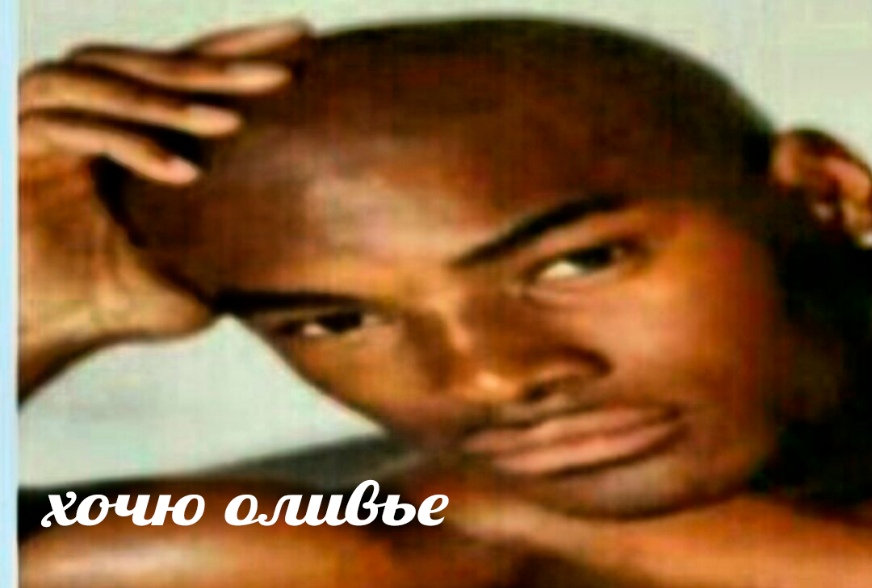
In the photo, a man lies propped on one elbow while the palm of his other hand touches his head. Over the photograph are the words “khochu olive” (“I want Olivier”), written here with the standard spelling of the letter “u.” The series contains the deliberately misspelled form “khochyu X,” and its title should not be confused with the text of this picture. In the meme author's recollection, this photo is connected to the model Tyson Beckford; the meme caption itself does not explain the original shoot. The contrast between an expressive pose and a short, homely wish is what matters. The phrase speaks in the voice of a fictional character created by the caption, not in the voice of the real person in the photo.
July publication and spread
Vladislav Bykov later said that he had already shared the image in June, and on July 17, 2018 he added “I want Olivier” to it in the group “Gruzoperevozki Sanki” during a VKontakte user flash mob. The next day, a screenshot of the exchange appeared in another community; on July 19, Sasha Bazhura collected several variants, after which participants began changing the captions and characters. This is how different dates took shape: the early spread of the photo itself by its author, the publication with Olivier, and the emergence of the repeatable series. In August, captions with other dishes and foods became noticeable. The meme grew out of a specific exchange, but its further life relied on a simple template that could be sent to another group or remade in a few minutes.
The mistake as part of the voice
The word “khochyu” looks like a typo, but its repetition turns the error into a recognizable manner. It is followed by the object of a very simple desire: Olivier, a watermelon, berries, or something else. Against the backdrop of a confident portrait, such an everyday request becomes unexpectedly solemn: the hero seems to address the world with a single important plea. This is irony at the junction of high visual pathos and a home grocery list. Later versions changed the depicted character, so the meaning depended less and less on the particular model and more and more on the combination of pose, error, and strangely serious “I want.” Within the flash mob, the short phrase was also convenient because it could be continued with a new food without rewriting the whole construction.
Invented desires
The invented caption “khochyu grechku” (“I want buckwheat”) under such a portrait turns an everyday side dish into an object of almost royal expectation. Another new variant, “khochyu tishiny” (“I want quiet”), would accompany the image in a residents' chat after noisy renovations: here the contrast between a majestic pose and a very understandable weariness is what matters. In a third invented situation, the hero on a school fair poster asks for “khochyu odin vykhodnoy” (“I want one day off”), with announcements about clubs and rehearsals posted around him. All three captions are invented and do not relate to Bykov's publications. What unites them is a grammatical formula that makes a simple request sound like an important public statement. If only the name of the food keeps changing, the object changes but the joke barely does; new contexts show that the construction works with desire, with exhaustion, and with comic seriousness alike.