What is visible in the frame
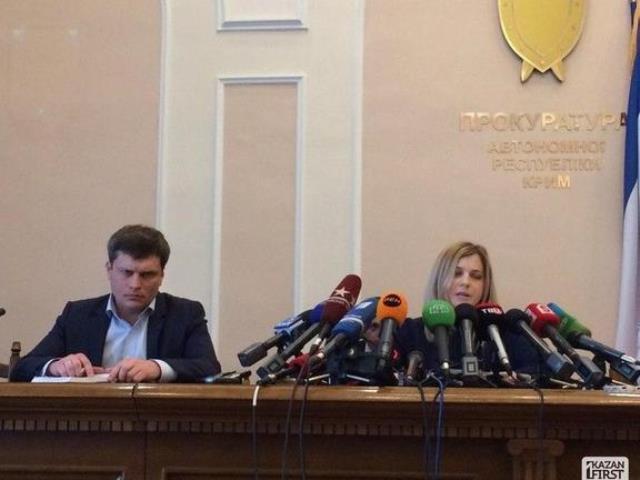
The photo was taken in a hall where a sign reading “Prosecutor's Office of the Autonomous Republic of Crimea” and a coat of arms are visible behind the seated people. Two people sit at a long wooden table: on the right, a woman with light hair; on the left, a man in a dark suit and light blue shirt with dark hair. In front of the woman stands a dense fan of microphones with multicolored logos of TV channels and radio stations.
The man looks down at the papers in front of him and appears focused or tired. The word “sad” in the title is the caption author's view, not something the photo itself confirms: mood cannot be judged from posture. In the lower right corner there is the logo of the outlet that took the photo.
Where the photo came from
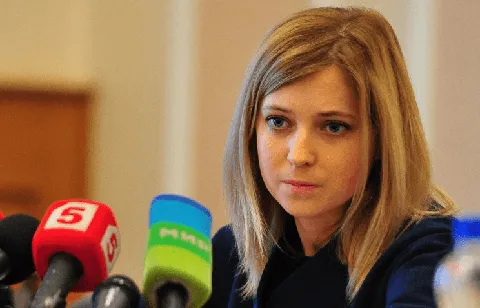
The woman in the photo is Natalia Poklonskaya, who served as Crimea's prosecutor in 2014; the photo is linked to her address to journalists. Who sits on the left has not been reliably established, so his role in the event and his name are not given.
The exact date of the shoot and the occasion of the press conference are described differently, so the frame should not be tied to a specific event. Understanding the joke does not require this: the meme rests on the composition, not on the people's biographies.
How the photo became a meme
The photo spread online already as a picture about the distribution of attention. Sources disagree on when the jokes began, and the first caption cannot be reliably named. The photo and the mass jokes based on it are separated in time, so the photo's creation date should not be passed off as the meme's birth date.
Later the template was applied to situations where one person gets all the attention and another gets none: siblings in a family, colleagues at a meeting, classmates at the blackboard. In every variant the meaning is the same: someone gets a dozen microphones shoved in their face while their neighbor goes unnoticed.
Caption examples
Example 1: “Came to the meeting, and all the questions went to my colleague's report.” The room and the distribution of attention stay the same; only the occasion changes: instead of news, it is a work meeting.
Example 2: “My older sister is talking about college admissions, and I'm next to her with the same school certificate.” The caption turns the frame into a comparison of two people side by side, and the viewer fills in for themselves who is in the spotlight.
Example 3: “Brought a cake home, and everyone is listening to the neighbor retell his vacation again.” The joke rests on the gap between the loudness of someone else's news and the quiet contribution of the person who is just standing nearby.
Each caption works through unequal attention: the face on the left stays a silent background, and the caption gives it a story.
Why the composition works
What is funny is not who sits at the table but how the objects are arranged. Dozens of microphones are concentrated in front of one person, while the space next to them is almost empty. The eye compares these two parts of the frame before it reads the caption, so the meme makes sense without text.
The joke should stay at the level of the frame and the distribution of attention, rather than being transferred to the personal traits of the people shown. Captions should not attribute events, relationships, or beliefs to them.
The template works best where the inequality of attention is comic rather than hurtful: a pie, a report, a grade for an essay. If a specific person can be guessed behind the caption, the joke loses its lightness.