The March hunt for three letters
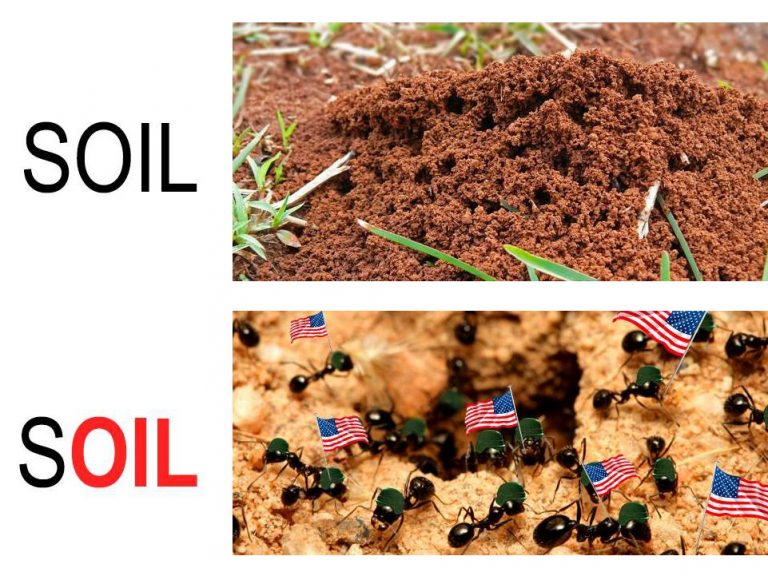
The format spread widely in March 2018 through Facebook, Reddit and Twitter. Compilations and specialized communities grew up around it, including American Oil Memes. Some images placed American soldiers next to a real tank of oil, while others found the word oil on signs and in names. Participants did not need a new photo of an oil field: a suitable set of letters was already enough material for a remake.
The idea rests on a political stereotype that US military action is driven by an interest in oil resources. The meme pushes this caricature to the point of automatism: find oil and an army appears at once. This pattern expresses the author's satirical attitude rather than proving the causes of any particular war. Its absurdity is especially visible where there is no oil and could not be any.
What happened to the ants in SOIL
The two panels use the English word soil, meaning earth. On top, the word is written in black beside a photo of the ground. On the bottom, the first letters stay black, but OIL is highlighted in red. Next to the inscription, ants with green helmets and American flags drawn on them now appear. The change in styling turns them into a small army, for which a verbal cue was enough to mobilize.
The ants are a particularly good choice here: they really do live in the ground and can move in groups. Because of this, the editing keeps its connection to the first panel, even though the added helmets completely change the meaning. The military scale shrinks down to the size of an insect. The result is a picture of a treasure hunt for something that exists only in the name of the creatures' habitat, not in the photo shown.
The word mistaken for a deposit
The pun requires two successive readings. First the viewer recognizes the ordinary word and the object it refers to. Then color or enlarged type makes them pick out the embedded oil. Different meanings stop being distinguished: crude oil, cooking oil and three letters inside a completely different word all provoke the same reaction. The editing pretends that the soldiers understand language exactly this way.
The first panel serves as the control state: everything is calm while the inscription is read as a whole. The second shows the consequences of a wrong reading. That is why even a static collage looks like a short story with a cause and an effect. The red highlighting plays the role of an alarm signal, and the flags make it possible to identify the participant in a political joke without a separate caption about a country.
New targets for a literal army
The invented bOIL variant could show a peacefully boiling kettle in the first panel and a landing party around it in the second. The English word boil means to boil, but the red letters declare the kitchen a strategic objective. The whistle of the kettle becomes a comic alarm, although the real reason the soldiers appear is only the styling of the inscription.
Another remake would use cOIL, a coil of wire. A neatly rolled cable lies on the table, and after the letters are highlighted, a tiny checkpoint lines up around it. The attack looks especially absurd here: an object cannot be turned into an oil well even with very diligent guards.
A third example would do without an embedded word: a bottle of aromatic oil unexpectedly receives a military escort. This is a game no longer with the boundaries of letters, but with the different meanings of oil. Like the ants in SOIL, all these squads carry out an excessively literal order. For the joke to work, the viewer only needs to see an innocent object and, at the same time, the reason for an erroneously inflated interest in it.