General description
The Russian doping scandal is a series of internet memes tied to accusations that Russian athletes used doping and swapped doping samples during the 2014 Sochi Olympic Games. The memes mocked both the accusations themselves and officials' reactions, as well as the banned substance meldonium, which became one of the symbols of the whole story.
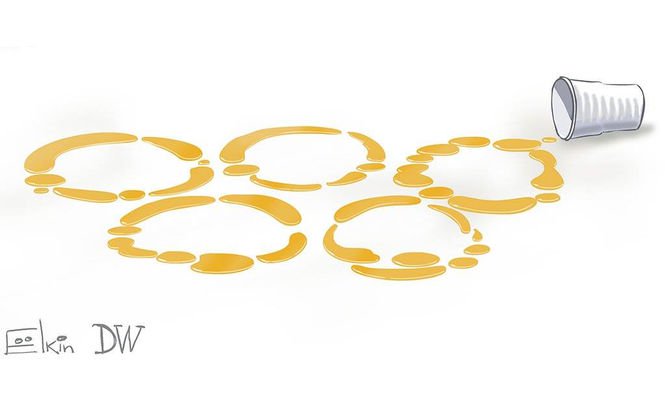
The illustration attached to the article is a cartoon captioned DW, in which the Olympic rings are formed out of a yellow viscous liquid pouring from an overturned jar. The image references the urine jokes that became one of the most recognizable elements of the topic. The cartoon matches the catalog's description; no discrepancies were found.
Background: the reports and sochi 2014
The memes were prompted by publications about the doping system in Russian sport. In 2016, an independent commission of the World Anti-Doping Agency, led by Canadian lawyer Richard McLaren, presented reports describing a scheme for swapping samples at the Moscow anti-doping laboratory during the Sochi Games. The reports also named the then sports minister Vitaly Mutko, who later became deputy prime minister.
A separate thread is tied to meldonium. The drug was added to the list of banned substances on January 1, 2016, and the explanations given by athletes in whose samples it was found became the subject of online irony. This detail is exactly what gave the scandal short, easily memorable meme phrases that could be inserted into any news caption.
The ioc's decision and the 2018 olympics
In December 2017, the International Olympic Committee suspended the membership of the Russian Olympic Committee and barred the national team from the Games in Pyeongchang. Athletes who had no doping violations and passed individual screening were able to compete under a neutral flag under the name "Olympic Athletes from Russia."
This phrasing itself became the occasion for jokes, since the memes were built on the contrast between official statements and what was actually happening. This format allowed users to briefly express irony about the news story without offering a detailed assessment of specific facts.
The memes and their content
The main memes relied on several comedic threads: urine as a symbol of the swapped samples, the surname Mutko, which often appeared in news captions, and meldonium as the name of the drug. The jokes were used in comments, photoshopped images, and cartoon captions, and also served as a quick response to each new publication about the scandal.
Some of the jokes spread as short drawn strips, which were published in media outlets and then circulated on social networks. This genre drew a wide response, since it relied on context that users already understood from the sports and political agenda, and it was often cited as an example of how news turns into a meme.
Origin and spread
The exact author of the first jokes and the date the memes appeared have not been established from open sources. Indirectly, the wave of memes appears to have risen at the peak of publications about Sochi and the subsequent committee decisions in 2016 and 2017, reaching a maximum around the IOC's decision at the end of 2017. The "2017" tag in the catalog corresponds to precisely this period.
The scandal remains part of internet folklore and is mentioned in the context of sport, doping, and relations between Russian sports bodies and international organizations. A search of open sources confirmed the main events but didn't yield reliable information about the first author of the memes, so this part of the story is described in the article without further specifics.